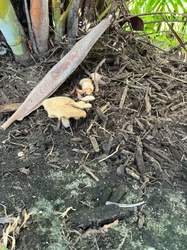
Wrinkled Fieldcap
Agrocybe rivulosa
Also called wrinkled agrocybe, mulch fieldcap
A tall pale fieldcap of fresh woodchip, recognised by its distinctly wrinkled and veined cap surface and the large flaring ring hanging from a white stipe.
Overview
Agrocybe rivulosa is a striking woodchip specialist that has spread dramatically through northwestern Europe in recent decades. It was scarcely recorded before the 1990s and is now one of the commonest large agarics of landscaped mulch beds, verges, roundabouts and park borders, its rise closely tracking the increasing use of chipped wood as ground cover in amenity planting.
Within the fieldcaps it stands out for two features. The first is the cap surface, which is not smooth like most of its relatives but strongly rugose, marked with a network of radiating wrinkles, veins and shallow ridges that are most pronounced from the centre outwards. The second is the ring: large, membranous, flaring and pendulous, hanging like a skirt from the upper stipe and collecting a heavy load of dark spores.
It belongs with the other saprotrophic Strophariaceae of disturbed and mulched ground, sharing habitat with Agrocybe praecox, Stropharia rugosoannulata and various inkcaps, and often fruiting in spectacular troops of dozens or hundreds of fruit bodies over a few weeks.
How to identify it
Cap
Typically 4-10 cm across, sometimes larger, hemispherical at first with a strongly inrolled margin, expanding to broadly convex and finally flat or slightly upturned. The colour is a pale cream-ochre, buff or pale tan, often almost whitish towards the margin and darker in the centre. The surface is dry and characteristically wrinkled, veined and pitted, giving a rippled or brain-like texture that is easiest to see in mature caps; the margin may hang with white veil fragments when young.
Gills
Adnate, crowded and fairly broad. They begin pale greyish-buff or clay, then darken through cinnamon-brown to a deep dark brown as the spores ripen, with paler, finely fringed edges under a lens.
Stipe
Tall and firm, 5-12 cm long and 8-15 mm thick, white to cream, cylindrical and often slightly swollen or bulbous at the base, which is bound to the chips by white mycelium. The most conspicuous feature is the large, membranous, flaring ring hanging in the upper third; it is white when fresh and rapidly becomes coated with dark brown spore dust, sometimes appearing almost black in old specimens.
Flesh & spore print
The flesh is white to pale buff, firm, and does not change colour when cut. The odour is faintly mealy. The spore print is dark brown, and the spores are smooth and ellipsoid with a germ pore, typical of the genus.
Where and when it grows
The habitat is highly specific: fresh, deep woodchip and bark mulch. It fruits on landscaped beds, road verges, roundabout plantings, park borders, forest track edges and any other site where chipped broadleaf wood has been spread in quantity. It generally appears within one or two seasons of the mulch being laid and declines as the chips break down and the substrate is colonised by other fungi.
Fruiting runs from early summer through autumn, later than A. praecox, with troops sometimes numbering many dozens of fruit bodies on a single bed. Originally described from northwestern Europe, the species has expanded rapidly across the continent with the movement of mulch material and is now widely reported elsewhere in temperate regions, a good example of a fungus whose distribution is shaped by human land management.
Ecological role
Agrocybe rivulosa is a saprotroph specialising in the early decomposition of fresh, lignin-rich woodchip. Freshly laid mulch is a resource-rich but chemically demanding substrate, and this species is among the fungi best equipped to colonise it quickly, spreading through the chip layer as a dense white mycelium and converting woody tissue into simpler compounds.
Its life cycle is fast and opportunistic. Spores or mycelial fragments arrive with the mulch or on the wind, the mycelium colonises the bed within months, and heavy fruiting follows in the first or second summer. As the chips soften and become mixed with soil, later-successional fungi displace it and fruiting ceases, so a given bed usually supports the species for only a few years. In the process it accelerates the incorporation of woody mulch into garden and verge soils.
Similar species
Agrocybe praecox is the closest relative in the same habitat but has a smooth or merely cracked cap rather than a wrinkled and veined one, a smaller and less flaring ring, a more slender stipe and an earlier, spring fruiting season. Agrocybe putaminum also occurs on chips but has a smooth tan cap and either no ring or a very faint one.
Stropharia rugosoannulata shares the mulch habitat and has an even more substantial ring, but that ring is thick and radially grooved into a cog-wheel pattern, its cap is wine-red to reddish-brown when fresh, and its spore print is purple-black rather than dark brown. Cyclocybe aegerita has a cracked tan cap and a ring but fruits in tufts on standing trunks and stumps of poplar, willow and elder, not on loose mulch.
Common questions about Wrinkled Fieldcap
What makes the cap look wrinkled?
Why has it become so common recently?
How long does a colony last on one mulch bed?
How does it differ from Stropharia rugosoannulata on the same mulch?
Wrinkled Fieldcap found by the community
Photos submitted through the app and matched to this entry.