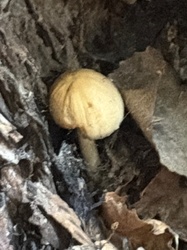
Yellow Fieldcap
Bolbitius titubans
Also called bolbitius vitellinus, egg yolk fieldcap, sunny side up
An extremely fragile, short-lived agaric whose slimy egg-yolk yellow cap expands, fades to grey and collapses within a day, leaving a rusty ochre spore print.
Overview
Bolbitius titubans is the type species of a small genus of very delicate, ephemeral agarics related to the fieldcaps and inkcaps. Everything about it is built for speed: the fruit body emerges, expands, sheds its spores and collapses within a single day, so a patch that is bright yellow at dawn can be an unrecognisable grey smear by evening.
It is widely known under the older name Bolbitius vitellinus, and the vivid colour of the young cap has given rise to English names referring to egg yolks. In the button stage the cap is a smooth, slimy, brilliant egg-yellow ovoid; as it expands the yellow drains outward and away, leaving a grey-buff, deeply grooved disc with a lingering yellow centre.
The genus sits close to Conocybe and Agrocybe in the Bolbitiaceae, sharing their brown to rusty spore prints, but its extreme fragility and gelatinous cap cuticle make it distinctive. It is one of the classic fungi of nutrient-rich grassland, straw and manure, and a familiar sight on lawns after summer rain.
How to identify it
Cap
Small, 1-5 cm across, at first a narrowly ovoid or egg-shaped button of vivid egg-yolk yellow, expanding rapidly to bell-shaped, then flat and finally upturned and split. The surface is smooth and distinctly slimy or viscid when fresh. As the cap opens, the yellow fades from the margin inwards to buff, grey-ochre or almost dirty white, often leaving a yellow centre, and the margin becomes deeply and coarsely grooved from the gills showing through the paper-thin flesh.
Gills
Narrowly adnexed to almost free, crowded and very thin. They are pale yellow or cream at first and turn cinnamon to rusty ochre-brown as the spores ripen, sometimes softening and partly liquefying in old caps, though not producing the true black ink of Coprinus.
Stipe
Very slender and fragile, 4-10 cm long and only 2-5 mm thick, hollow, cylindrical and often slightly wider at the base. It is white to pale yellow, sometimes yellower towards the top, and finely mealy or powdery over the whole length, giving a frosted appearance. There is no ring and no volva, and the stipe snaps at the slightest pressure.
Flesh & spore print
The flesh is extremely thin, watery and pale, unchanging, with no distinctive odour. The spore print is a warm rusty ochre-brown, an important separation from the black-spored dung agarics; the spores are smooth, thick-walled and have a germ pore.
Where and when it grows
The Yellow Fieldcap grows on nutrient-rich, decomposing plant material. Typical sites include manure heaps, well-rotted dung on pasture, rotting straw, hay residues, compost, grass clippings, rich lawns, woodchip and the fertilised margins of arable fields. It fruits singly or in scattered groups, often in numbers after warm rain, and appears wherever nitrogen-rich organic matter meets moisture.
The season is long, from spring through to late autumn, with peaks in warm humid weather in summer. Because fruit bodies last less than a day, the fungus is often present on a site far more frequently than casual observation suggests. It is cosmopolitan, recorded from every continent except Antarctica, and travels readily with agricultural materials such as straw and manure.
Ecological role
Bolbitius titubans is a saprotroph of nitrogen-rich decomposing plant material and dung. It breaks down straw, grass thatch and herbivore droppings, releasing nutrients back into the soil and forming part of the community of coprophilous and litter-decomposing fungi that recycle organic matter in grazed and cultivated ground.
Its strategy is that of an extreme opportunist. The mycelium builds resources in a rich but transient substrate and then invests them in a very rapid, very cheap fruit body: paper-thin flesh, a hollow fragile stipe and a life measured in hours. Spores are shed within a few hours of the cap opening, and the whole structure then collapses, minimising the time and material exposed to drying and grazing. This boom-and-bust cycle can be repeated many times through a warm, damp season.
Similar species
Bolbitius reticulatus is a close relative but is greyish-lilac with a veined or reticulate cap surface and grows on decaying broadleaf wood rather than grass or dung. Conocybe species share the fragile build and rusty spores but have dry, conical to bell-shaped caps that are never slimy or bright yellow, and their stipes are usually finely striate rather than mealy.
Parasola and Coprinellus species are equally fragile and grooved but are grey to tan rather than yellow and produce a black spore print, with gills that darken to black or dissolve into ink. Agrocybe pediades occupies the same turf but is much firmer, with a dry hemispherical ochre cap, a non-grooved margin and a dark brown rather than rusty ochre spore print.
Common questions about Yellow Fieldcap
How long does a fruit body last?
Why does the cap change from yellow to grey?
What is the spore print colour?
What does it grow on?
Yellow Fieldcap found by the community
Photos submitted through the app and matched to this entry.