Community find
Yellow Fieldcap or Sunny Side Up Mushroom
Bolbitius titubans
- Group
- gilled mushroom
- Spore print
- Rusty-brown or ochre-brown.
- Size
- Cap 1-5 cm diameter; Stipe 3-10 cm height by 2-5 mm width.
- Season
- Typically appears in spring, summer, and autumn after heavy rainfall.
- Habitat
- Grows in nutrient-rich areas such as fertilized lawns, gardens, compost heaps, mulch, and dung-enriched pastures.
- Distribution
- Widely distributed across North America, Europe, and many other temperate regions globally.
- Key characteristics
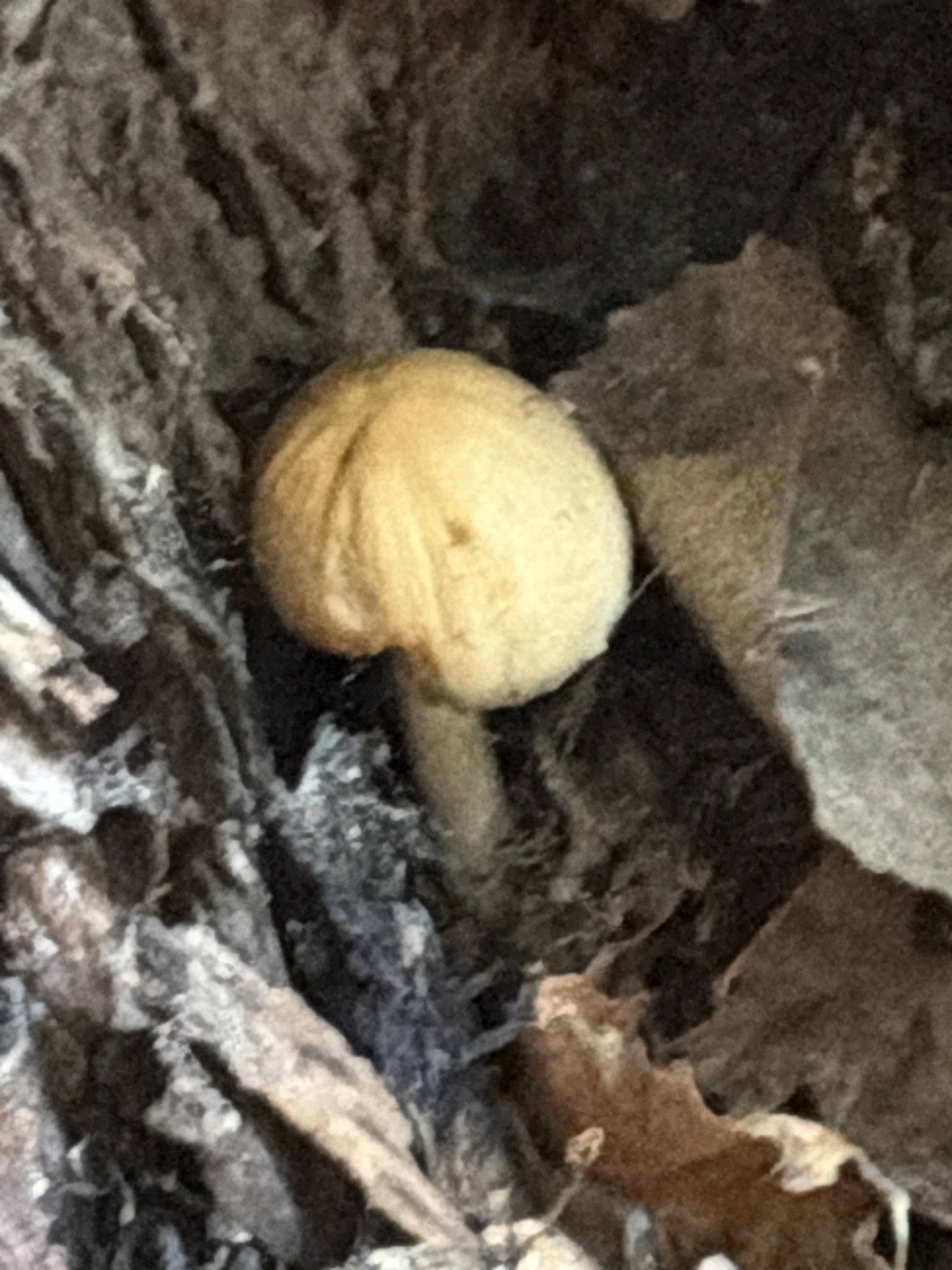
- A small, fragile mushroom with a bright yellow, slimy cap when young that fades to pale greyish-yellow and becomes radially grooved or striate as it matures. The stem is thin, hollow, and pale yellow.
- Fruiting body
- Cap: 1-5cm, initially egg-shaped and bright yellow, becoming convex or flat and pale with age; surface is viscid (slimy) and the margins are deeply striate. Hymenophore: Gills are free or narrowly attached, crowded, initially yellow-white, turning rusty-brown with spore maturity. Stipe: 3-10cm long, 2-5mm thick, very fragile, pale yellow, and pruinose (covered in fine powder).
- How to recognise it
- Look for the bright yellow, slimy cap that rapidly fades and collapses, the presence of rusty-brown gills when mature, and the fragile, yellowish stem without a ring.
- Look-alikes
- Bolbitius reticulatus (grows on wood, grey-violet cap), Leucocoprinus birnbaumii (brighter yellow, often in potted plants, has a ring on the stem).
- Ecological role
- Saprophytic, breaking down organic matter in soil, dung, or rotting vegetable debris.
- Notes
- This species is extremely ephemeral, often appearing shortly after sunrise and withering away by the afternoon, leading to its nickname 'Sunny Side Up' mushroom. It is often used in studies regarding the decomposition of dung and grassland ecology.