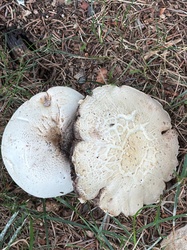
Yellow-staining Mushroom
Agaricus xanthodermus
Also called yellow stainer, yellow-staining agaricus
A white Agaricus of hedges and parks whose flesh flushes instant chrome-yellow when rubbed, most vividly in a cut stem base, and which carries a sharp phenolic odour. The young cap is characteristically squared off.
Overview
The Yellow Stainer is the best known member of a small group within Agaricus defined by an immediate bright yellow discolouration and a sharp chemical odour. Agaricus belongs to the family Agaricaceae and is recognised by free gills that pass from pale through pink to chocolate-brown, a dark brown spore print, and a ring left by the partial veil. Within the genus, species are sorted largely by how and how fast they stain and by what they smell of.
A. xanthodermus stains faster and more vividly than almost any relative. A fingernail drawn across the cap margin leaves a bright chrome-yellow line within seconds, and a fruiting body cut lengthwise through the base of the stem shows a brilliant yellow flush in the basal flesh that fades to dingy brown over several minutes. This reaction is paired with a penetrating odour usually described as phenolic, inky or of carbolic soap, strongest at the stem base.
The species forms a group with several close relatives, including the darker-capped Agaricus moelleri and the woodland A. phaeolepidotus, which share the yellow reaction and phenolic scent but differ in cap scaling. Together they are among the most frequent large white Agaricus species of gardens, parks and hedgerows across Europe and North America.
How to identify it
Cap
5-15 cm across, distinctly angular when young, forming a squared-off block with a flat top and abrupt vertical sides, then expanding to broadly convex and finally flat with a slightly depressed or flattened centre. The surface is smooth and dry, white to greyish-white, sometimes cracking into fine flat greyish scales over the crown with age. Rubbing the margin produces a strong, immediate chrome-yellow stain that later dulls to brownish.
Gills
Free from the stem and crowded, at first covered by the white veil, then whitish to a dull greyish-pink, never the clean bright pink of the Field Mushroom, and finally passing through dark brown to almost blackish chocolate at maturity.
Stipe
6-15 cm tall and 1-2.5 cm thick, white, smooth, hollow at maturity, and usually with a distinctly swollen or abruptly bulbous base. The ring is large, white, pendulous and persistent, and its underside typically bears a soft cogwheel-like pattern of radiating flaps. Slicing the stem lengthwise through the bulb reveals the diagnostic instant bright chrome-yellow flush in the basal flesh.
Flesh & spore print
Flesh is white and firm, yellowing immediately and intensely at the extreme stem base, more weakly elsewhere, and the yellow fades toward dull brown within minutes. The odour is unpleasant, sharply phenolic or of ink and carbolic, and is most obvious from the cut stem base. The spore print is dark chocolate-brown.
Where and when it grows
This species prefers rich, disturbed, partly shaded ground rather than open pasture. It fruits under and along hedgerows, in gardens and allotments, in shrubberies, on woodland edges and rides, along path and road verges, in parks, churchyards and amenity grassland, and in mulched beds and compost-enriched borders. It frequently appears in troops, arcs and large fairy rings on lawns and in long grass beneath trees.
Fruiting runs from early summer through to late autumn, often starting earlier in the year than most large Agaricus species and continuing until the first frosts. It is common and widespread throughout Europe, occurs across temperate Asia and North America, and has been introduced with horticulture to Australia, New Zealand and parts of southern Africa and South America, where it is often abundant in urban parkland.
Ecological role
The Yellow Stainer is a saprotroph of nutrient-rich soil. Its mycelium spreads through the humus layer and upper mineral soil, decomposing leaf litter, grass thatch, mulch and other accumulated organic matter, and it forms no partnership with tree roots. Its strong association with hedge bottoms, shrubberies and mulched borders reflects the concentration of decaying plant material in those places rather than any preference for particular tree species.
Because it responds quickly to organic enrichment, it is one of the large fungi most likely to colonise newly mulched or landscaped ground, and it can appear in numbers within a season or two of soil disturbance. The mycelium expands outward through the soil, exhausting resources behind it, so long-established colonies produce conspicuous arcs and rings of fruiting bodies in lawns. Its broad gill surface releases very large quantities of dark spores over several days.
Similar species
Agaricus campestris, the Field Mushroom, is the closest match in colour but has clean bright pink young gills, a thin fragile single ring, a stem tapering rather than bulbous at the base, no chrome-yellow flush, and a pleasant mushroomy odour; it also grows in open grazed grassland rather than hedge bottoms. Agaricus arvensis does yellow, but slowly and to a soft straw colour, smells sweetly of almonds, and lacks the abruptly bulbous stem base.
Agaricus augustus is far larger, with a cap covered in tawny fibrillose scales rather than a smooth white surface, and yellows slowly with an almond scent. Agaricus moelleri shares the instant yellow reaction and phenolic odour but has a cap patterned with dark grey-brown fibrillose scales. Leucoagaricus leucothites is white throughout with gills that stay pale and a white spore print. The reliable test is a vertical cut through the stem bulb: an immediate brilliant chrome-yellow flush with a phenolic odour identifies this species.
Common questions about Yellow-staining Mushroom
What is the quickest field test?
How does the odour help?
Why does the young cap look squared off?
Where is it most often found?
Yellow-staining Mushroom found by the community
Photos submitted through the app and matched to this entry.