Community find
American yellow fly agaric
Amanita muscaria var. guessowii
- Group
- gilled mushroom
- Spore print
- White
- Size
- Cap 5-18 cm diameter; stipe 6-15 cm long and 1-3 cm thick.
- Season
- Typically fruits from late summer through late autumn.
- Habitat
- Mycorrhizal association with deciduous and coniferous trees, often found near oak, pine, and birch in lawns, parks, and forests.
- Distribution
- Clade predominantly found in Northeastern North America and parts of the Midwest.
- Key characteristics
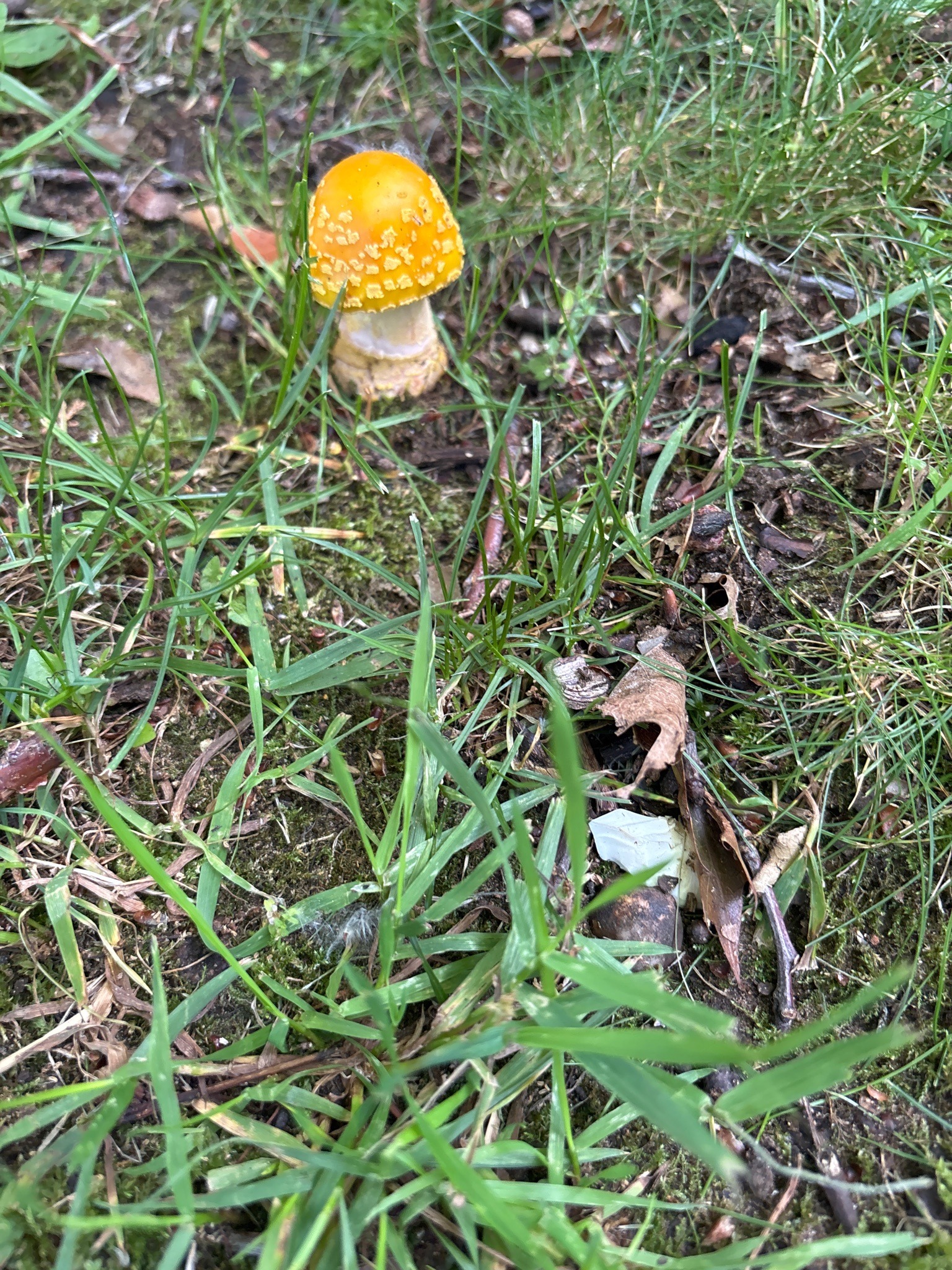
- Bright yellow to orange cap covered with pale yellow to white warts. White gills, white stipe with a ring, and a bulbous base featuring concentric rings of universal veil tissue.
- Fruiting body
- Cap is initially globose, becoming convex to flat, surface is sticky when moist. Gills are free from the stipe, close, and white. Stipe is cylindrical, white to pale yellow, with a persistent skirt-like ring and a basal bulb with scaly ridges.
- How to recognise it
- Look for a yellow-orange cap with yellow warts, a white stem with an apical ring, and a bulbous base with 2-4 distinct rings of tissue above the bulb.
- Look-alikes
- Amanita frostiana (smaller, different volva structure), Amanita flavoconia (yellow warts, different base), and Amanita wellsii (velvety orange-yellow cap).
- Ecological role
- Mycorrhizal fungus that forms a symbiotic relationship with tree roots, aiding in nutrient and water absorption.
- Notes
- This variety is a North American relative of the iconic red Amanita muscaria. The DNA of this variety shows it is distinct from the European red fly agaric, despite similar physical features besides color. It is often used in scientific studies of fungal genetics and symbiosis.