Fly Agaric
Amanita muscaria
Also called fly amanita, fly mushroom
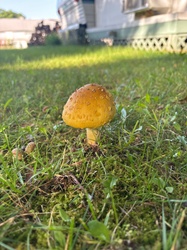
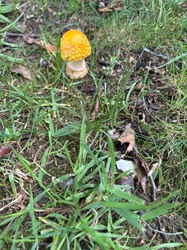
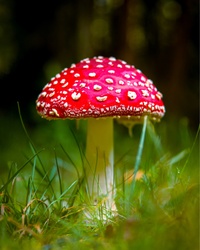
The archetypal storybook mushroom: a scarlet or orange cap sprinkled with white warts, standing on a white stem with a skirt-like ring and a bulbous base ringed by concentric scaly girdles.
Overview
Amanita muscaria is probably the most instantly recognisable fungus in the world, its red-and-white colouring reproduced in illustration far more often than it is observed in the field. It belongs to Amanita, a large genus in the family Amanitaceae characterised by free gills, a white spore print, and a fruiting body that emerges from an egg-like universal veil. In A. muscaria that veil breaks up into the loose white flakes scattered across the cap surface, while the partial veil covering the young gills is left behind as a hanging ring on the stem.
The species is not a single uniform entity but a complex of closely related regional populations. European material is typically deep scarlet, while much of eastern North America carries the yellow-to-orange var. guessowii and the mountain west carries the red var. flavivolvata. Siberian and Alaskan forms tend toward orange with sparser veil remnants. Genetic work suggests the complex radiated across the Northern Hemisphere from a Siberian-Beringian origin, spreading with its tree partners.
Its distinctiveness lies in the combination of features rather than colour alone: a brightly coloured cap that is dry and slightly sticky when wet, pure white free gills, a white stem, a soft pendulous ring, and a swollen stem base wrapped in several shaggy concentric bands rather than a loose membranous bag. Because it is ectomycorrhizal, it has followed birch, pine and spruce plantings around the globe and now fruits in parts of Australia, New Zealand, South Africa and South America where it was never native.
How to identify it
Cap
5-20 cm across, at first a bright hemisphere, expanding to convex and finally almost flat with a slightly grooved margin in age. The surface is scarlet, blood-red, orange-red or (in some regional forms) yellow to orange, fading toward the margin and paling markedly in sun and rain. It is dotted with numerous white to cream, cottony, pyramidal warts arranged in loose concentric rings; heavy rain can wash these away entirely, leaving a bare red cap that is much harder to place. The surface is slightly tacky when moist and shiny when dry.
Gills
Free from the stem, crowded, broad, pure white to very faintly cream, with a minutely floccose edge. Short gills of several lengths are interspersed between the full-length ones. The gills never take on pink or brown tones as they mature.
Stipe
5-20 cm tall and 1-3 cm thick, white, dry, often finely shaggy or scurfy, tapering slightly upward and hollowing with age. A soft, white, pendulous, skirt-like ring hangs from the upper third and may be torn or collapsed in older specimens. The base swells into a distinct oval or club-shaped bulb encircled by two to four concentric shaggy rings or girdles of universal veil tissue. This girdled bulb, rather than a loose membranous sac, is one of the key structural features of the species.
Flesh & spore print
Flesh white throughout, sometimes flushed yellow or orange directly beneath the cap skin, and unchanging or only faintly discolouring when cut. Smell faint and slightly earthy. The spore print is white, and the spores are smooth, broadly elliptical and non-amyloid.
Where and when it grows
Fly Agaric is ectomycorrhizal and fruits only where a compatible tree is present. Its commonest partners are birch, pine, spruce, fir and larch, with beech and oak used less frequently. It favours acidic, sandy or well-drained soils and appears along woodland tracks, in heathy birch scrub, under planted conifers, and on the mossy margins of forest clearings, often in scattered arcs or loose troops where the underground network has spread.
Fruiting runs from late summer into late autumn in most of the temperate Northern Hemisphere, continuing into early winter in mild oceanic climates. The species is native across Europe, northern Asia and North America, and has been introduced with nursery stock and forestry plantings to Australia, New Zealand, South Africa, Chile and other regions, where it fruits under exotic birch, pine and eucalypt.
Ecological role
As a mycorrhizal fungus it sheathes the fine root tips of its host tree in a fungal mantle and extends hyphae between the outer root cells, forming the structure known as a Hartig net. Through this interface the fungus supplies the tree with water, phosphorus and nitrogen drawn from a soil volume far greater than the roots alone could reach, and receives sugars produced by photosynthesis in return. The relationship is obligate for the fungus, which cannot fruit without a partner.
In some introduced ranges A. muscaria has proved unusually good at switching to new hosts, colonising native trees such as southern beech and eucalypt and spreading outward from plantation edges. It is also a notable component of northern forest ecology as a physical structure: the fruiting bodies host specialised fly larvae, beetles and mould fungi, and their rapid collapse returns nutrients to the litter layer within a fortnight.
Similar species
Caesar's Mushroom (Amanita caesarea) shares an orange cap but has a smooth cap free of warts, a strongly grooved cap margin, deep golden-yellow gills and stem, and a large white membranous sac at the base rather than concentric girdles. Rain-washed Fly Agaric that has lost its warts can be separated by the white gills and stem and the girdled bulb.
Red-capped Russula species such as Russula emetica are also bright red but have no ring and no swollen base at all, and their flesh and gills are brittle and snap cleanly like chalk rather than tearing in fibres. The Panther Cap (Amanita pantherina) has the same warty construction but a brown to greyish-brown cap, a sharply grooved margin, and a bulb finished with a distinct collar-like rim. Yellow North American forms of Fly Agaric can suggest Amanita gemmata, which is paler straw-yellow with a thinner ring and fewer, more fragile veil patches.
Common questions about Fly Agaric
What makes the base of the stem so distinctive?
Do the white warts always stay on the cap?
Why do some Fly Agarics look yellow or orange instead of red?
Which trees does it grow with?
Guides
Fly Agaric found by the community
Photos submitted through the app and matched to this entry.