Community find
American yellow fly agaric
Amanita muscaria var. guessowii
- Group
- gilled mushroom
- Spore print
- White
- Size
- Cap diameter ranges from 5 to 15 cm; stipe length is 6 to 15 cm with a thickness of 1 to 3 cm.
- Season
- Typically fruits from late summer through late autumn.
- Habitat
- Grows in a mycorrhizal relationship with both coniferous and deciduous trees, frequently found under pines, spruces, and birches in lawns, parks, and woodlands.
- Distribution
- Common throughout northeastern North America and parts of the Midwest.
- Key characteristics
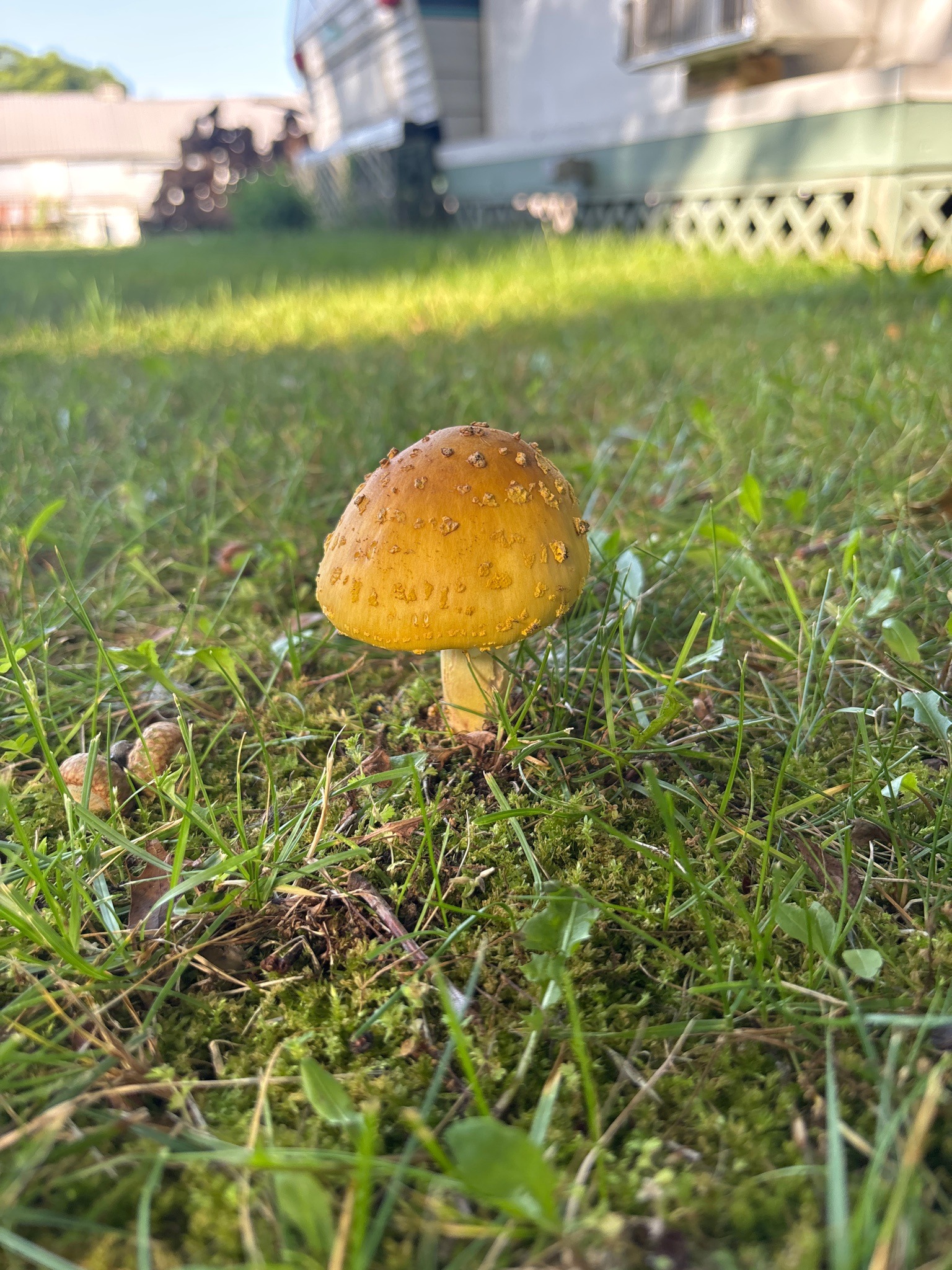
- Yellow to orange-yellow cap covered with small, pale yellow to whitish warts or patches. The stem is whitish to pale yellow with a bulbous base and a fragile ring. Gills are white and closely spaced.
- Fruiting body
- The cap is hemispherical when young, expanding to convex and then nearly flat. The surface is smooth and viscid when wet, decorated with remnants of the universal veil. The lamellae (gills) are free from the stipe. The stipe features a pendant, skirt-like ring and a base surrounded by concentric rings of veil tissue.
- How to recognise it
- Look for the bright yellow to orange cap, the presence of warts, and the scaly, bulbous base of the stem with concentric rings.
- Look-alikes
- Amanita flavoconia (yellow patches, lack of concentric rings at base), Amanita frostiana (smaller size, different striations on cap margin).
- Ecological role
- Mycorrhizal, forming a symbiotic relationship with tree roots to exchange nutrients for carbohydrates.
- Notes
- This variety is a North American relative of the classic red-capped Eurasian fly agaric. It has been a subject of extensive mycological study regarding its fungal genetics and distribution patterns across the continent.