Community find
Artist's Conk, Artist's Bracket
Ganoderma applanatum
- Group
- Polypore
- Season
- It is a perennial fungus, meaning it can be found year-round. New growth occurs primarily during warmer, humid months, but the woody conk persists through all seasons.
- Habitat
- It is a saprophytic fungus, typically found growing on dead or dying hardwood trees, such as oak, maple, beech, and birch. It can also be found on conifers, but less commonly. It grows in forests, woodlands, and urban environments where suitable dead wood is present.
- Key characteristics
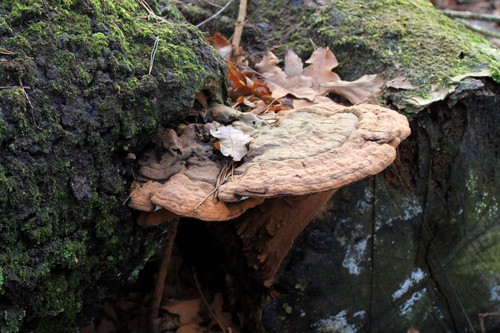
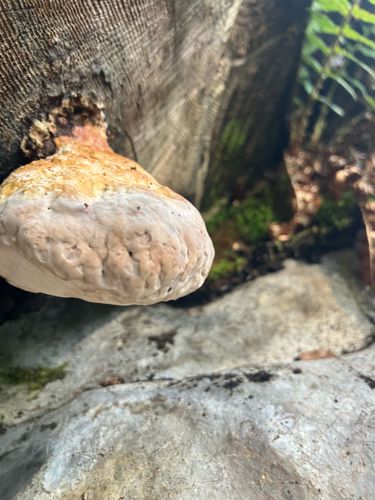
- The Artist's Conk is a large, perennial polypore. Its cap is typically flat or shelf-like, often several inches to over a foot across, and can be gray to brownish with concentric growth rings. The upper surface is hard, woody, and may be covered with a fine, powdery, reddish-brown spore dust. The most distinctive feature is the pure white pore surface, which bruises dark brown or black when scratched or pressed, hence its common name (artists traditionally use it to draw on its surface). The flesh is tough and corky, reddish-brown.
- Look-alikes
- Similar species include other shelf fungi and species within the Ganoderma genus. Ganoderma adspersum is very similar but usually has a duller, rougher cap surface and a more pronounced margin. Ganoderma tsugae (Hemlock Varnish Shelf) has a shiny, varnished appearance and typically grows on conifers.
- Ecological role
- Ganoderma applanatum is a saprophytic fungus, playing a crucial role as a decomposer of dead wood, primarily hardwoods. It causes a white rot, breaking down lignin and cellulose, which helps recycle nutrients back into the ecosystem. As a perennial, it can persist on a host tree for many years, slowly consuming the wood.