Artist's Conk
Ganoderma applanatum
Also called artist's bracket, artist's fungus, flat polypore
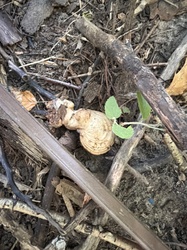
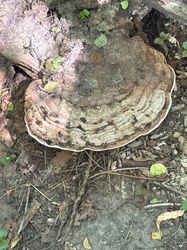
A large perennial shelf fungus with a hard, lumpy grey-brown crust and a chalk-white pore surface that instantly bruises dark brown where scratched, the feature behind its name.
Overview
The Artist's Conk is one of the largest and longest-lived bracket fungi of temperate broadleaved forest. Unlike the annual polypores that rot away each winter, Ganoderma applanatum is perennial: each year the fruit body adds a new layer of tubes beneath the previous one and extends the crust outward, so a mature bracket contains a stack of tube layers that records its age and may persist for a decade or more, occasionally reaching 60 cm or more across.
Its common name comes from the pore surface. The fresh underside is a flat, even, chalk-white sheet of minute pores that turns dark chocolate brown the instant it is touched or scratched, so a fingernail or stylus can draw a permanent brown line on white. Dried conks have been used as a drawing surface for etched images for generations, and the effect is unmistakable in the field.
Ganoderma is a large, cosmopolitan genus in the Polyporales, divided informally into the varnished species with a lacquered upper surface, such as the reishi group, and the unvarnished species like G. applanatum whose crust is dull, dry and often coated in a layer of rusty brown spore dust. The genus is defined microscopically by its double-walled, truncated spores with an ornamented inner wall.
How to identify it
Fruiting body
A hard, woody, semicircular to fan-shaped bracket 10-60 cm across and 2-8 cm thick, attached broadly to the wood without a stalk, usually growing singly or in overlapping tiers low on a trunk. The upper surface is dull, dry and matt, never lacquered, with a hard crust that is lumpy, warty and marked with concentric ridges and furrows corresponding to seasons of growth. Colour ranges from grey to greyish brown and dull ochre-brown, often obscured by a thick layer of cocoa-brown spore powder shed from brackets above, and older brackets are frequently colonised by green algae.
Pores
The underside is flat and even, white to cream when fresh and actively growing, composed of very fine round pores, roughly four to six per millimetre, so the surface looks smooth to the naked eye. Any pressure, scratch or bruise turns the touched area dark brown immediately and permanently, which is diagnostic. In cross-section the tube layer is stratified into distinct annual layers, each 0.5-2 cm deep, usually separated by thin lines of brown context tissue.
Context and margin
The flesh inside is corky to woody and fibrous, cinnamon-brown to reddish brown, sometimes with paler streaks or white flecks. The growing margin is a narrow, blunt, white to cream band during the growing season and hardens to the colour of the rest of the crust when growth stops.
Spore print
Rusty to cocoa brown, produced in enormous quantity, often visible as a brown film coating the bracket itself, the trunk below and any surrounding vegetation.
Where and when it grows
Ganoderma applanatum grows on the trunks, stumps, fallen logs and exposed roots of broadleaved trees. Beech, poplar, maple, elm, oak, willow, birch, horse chestnut and lime are all frequent hosts, and it occurs occasionally on conifers. Brackets typically form low down, often within a metre of ground level, on standing trees that are old, wounded or in decline, and on dead stumps and fallen trunks in woodland, parkland and along streets.
Because the fungus is perennial the fruit body is present all year round and can be found in any season. New growth and spore release occur mainly from late spring through autumn, when the fresh white margin is visible and a brown dust of spores accumulates on the upper surfaces. The species is widespread across the temperate northern hemisphere in Europe, Asia and North America, with closely related taxa in other continents.
Ecological role
This fungus is both a parasite of living trees and a saprotroph on dead wood. It causes a white rot, meaning it can break down lignin as well as cellulose and hemicellulose, leaving the residual wood pale, soft, fibrous and spongy. Infection usually enters through wounds, broken branches or root damage and progresses as a butt and trunk rot that hollows out the heartwood while the tree remains alive, often for many years.
The hollowing it causes is ecologically valuable, creating cavities used by birds, bats and invertebrates, and structurally weakened trees eventually fall and return their mass to the forest floor. The fungus also hosts a specialised community of its own: the yellow flat-footed fly Agathomyia wankowiczii induces distinctive nipple-shaped galls on the pore surface, a phenomenon almost unique among fungi. Spore output is prodigious, with mature brackets estimated to release many billions of spores per day during the season.
Similar species
Ganoderma australe, the Southern Bracket, is very similar and often occurs on the same hosts. It generally has a much thicker, harder crust that cannot be dented with a thumbnail, a more strongly humped profile and thinner annual tube layers; separating the two reliably requires spore measurements. Ganoderma lucidum and its relatives are separated instantly by their glossy, lacquered reddish upper surface and their frequent lateral stalk.
Fomes fomentarius, the Hoof Fungus, is hoof-shaped rather than flat and shelf-like, has a smooth grey banded crust and a grey-brown pore surface that does not stain dark brown when scratched. Phellinus and Fomitiporia species are also perennial and stratified but have brown to rusty pore surfaces from the outset and pore layers that lack the flat white bruising sheet. Fomitopsis pinicola has a banded crust with a red or orange zone, a pale cream pore surface and produces a brown rot, and its context is pale rather than cinnamon.
In every case the combination of a flat, dull, unvarnished grey-brown crust, a pure white pore surface that writes dark brown at a touch, cinnamon-brown corky context and stratified annual tube layers identifies the Artist's Conk.
Common questions about Artist's Conk
Why is it called the Artist's Conk?
How can I tell how old a bracket is?
What kind of decay does it cause?
How is it separated from a reishi-type Ganoderma?
Guides
Artist's Conk found by the community
Photos submitted through the app and matched to this entry.