Community find
Bicolor Bolete (complex)
Baorangia bicolor (formerly Boletus bicolor)
- Group
- bolete
- Spore print
- Olive-brown
- Size
- Cap diameter 5-15 cm; Stipe length 5-10 cm, thickness 1-3 cm.
- Season
- Summer to early autumn, typically after heavy rainfall.
- Habitat
- Found growing on the ground in association with deciduous trees, especially Oaks (Quercus). It is often found in lawns, parks, and wooded edges.
- Distribution
- Common in Eastern North America, ranging from Canada down to Florida and west to the Great Plains.
- Key characteristics
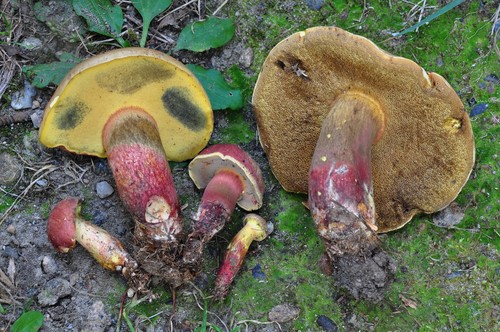
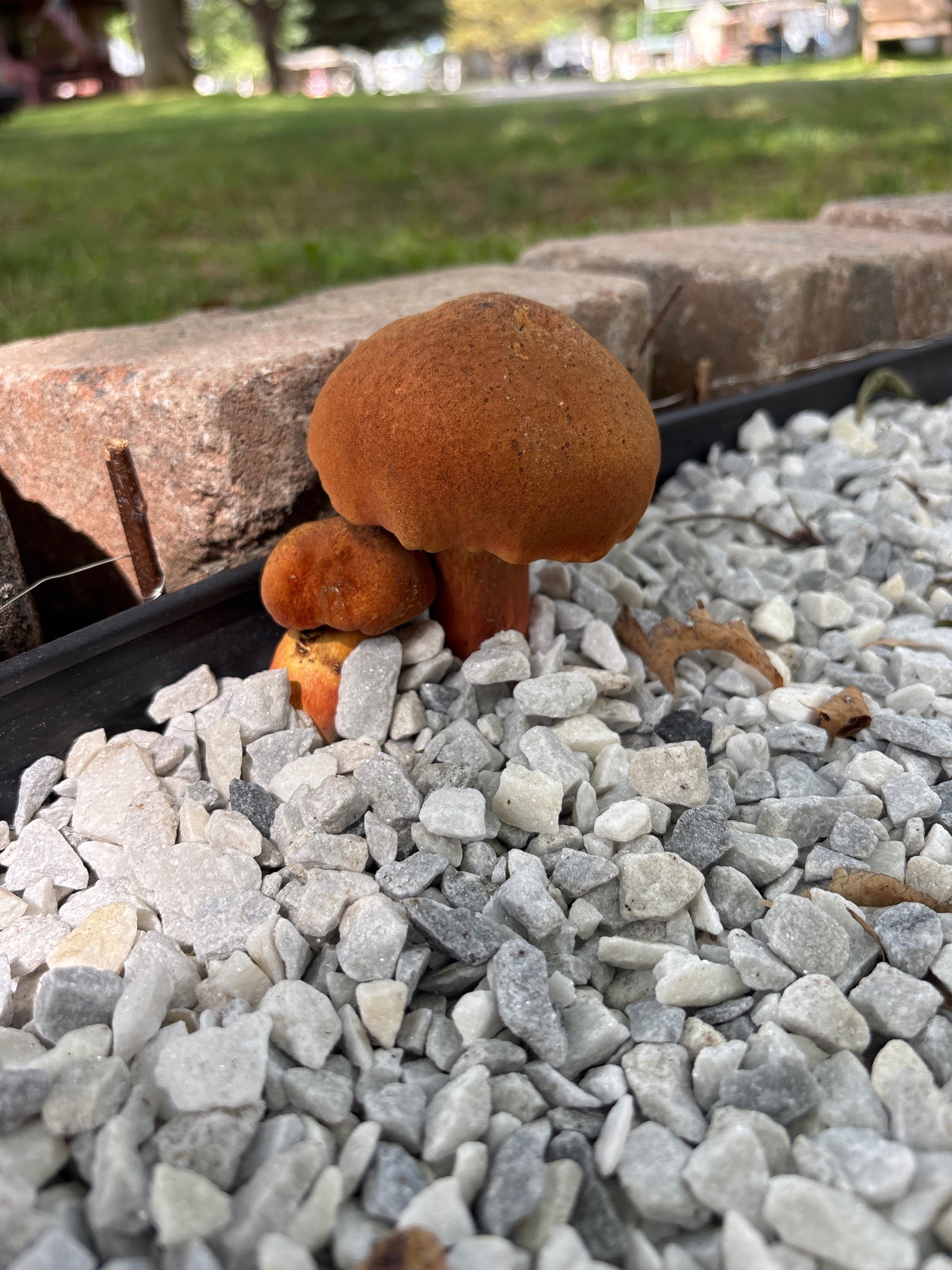
- Convex to flat cap that is deep brick-red to dull red-orange; yellow pores that bruise blue slowly; a thick, red stipe usually with yellow at the very apex.
- Fruiting body
- Cap is 5-15cm, dry, finely velvety when young; Hymenophore consists of tube-like pores that are yellow and stain blue when bruised; Stipe is 5-10cm long, solid, mostly red but turning yellow at the top.
- How to recognise it
- Look for a red cap and red stem with yellow pores that bruise blue slowly rather than instantly. The stem usually lacks reticulation (net-like patterns).
- Look-alikes
- Xerocomellus chrysenteron (cracked cap), Neoboletus luridiformis (instant blue bruising), and Hortiboletus campestris (smaller size).
- Ecological role
- Mycorrhizal, forming a symbiotic relationship with the root systems of hardwood trees, aiding in nutrient exchange.
- Notes
- This species is part of a complex of several genetically distinct but visually similar mushrooms. Its ability to thrive in urban settings like landscaped gardens and lawns makes it a very common sight for homeowners.