Two-colored Bolete
Baorangia bicolor
Also called bicolor bolete, red and yellow bolete
A handsome eastern North American oak bolete with a rose-red dry cap, bright yellow pores that bruise slowly blue, and a red stipe with a yellow apex and no net.
Overview
Baorangia bicolor, still widely listed as Boletus bicolor, is one of the most familiar boletes of eastern North American oak woods. The name refers to the sharp contrast between the rosy red cap and stipe and the vivid chrome-yellow pore surface, a colour scheme that makes it stand out even at a distance in leaf litter.
It was moved out of Boletus into the genus Baorangia on molecular grounds, joining a small group of red-and-yellow boletes characterised by relatively thin tube layers, a smooth unreticulated stipe and a slow, weak blue reaction to bruising. That sluggish blueing is one of its most useful field characters, because the several species it is confused with react far more quickly.
It is common, often abundant, and highly variable in cap tone, ranging from deep brick and rose to washed-out pinkish-tan in old or sun-exposed specimens.
How to identify it
Cap
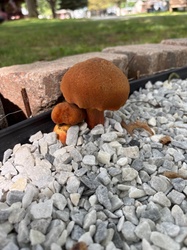
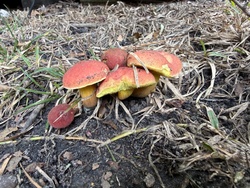
The cap is 5-15 cm across, convex becoming broadly convex to flat. It is rose-red, brick-red or purplish-red when fresh, commonly fading to pinkish-tan or dull brownish-pink with age and weather. The surface is dry and finely velvety at first, becoming smooth, and mature caps often crack into a shallow mosaic showing yellow flesh in the fissures.
Pores
The pore surface is bright chrome to golden yellow, ageing duller and more olive. The pores are small and round to slightly angular, and the tube layer is comparatively shallow. When bruised the surface stains blue, but characteristically slowly - taking several seconds to a minute - and the resulting colour is often a modest slate blue rather than an intense indigo.
Stipe
The stipe is 5-12 cm tall and 1-3 cm thick, solid, roughly equal or slightly swollen below. It is bright yellow at the extreme apex and red to rose over most of its length, often paler and yellowish again at the very base. Crucially it is smooth, sometimes finely dotted, but never carries a raised network.
Flesh & spore print
The flesh is pale yellow, thick and firm, and turns slowly and weakly blue when cut, sometimes only faintly and often reverting. The spore print is olive-brown.
Where and when it grows
This is a bolete of broadleaf woodland in eastern North America, from southern Canada and New England south to the Gulf states and west to the Great Lakes and eastern Texas. It is strongly associated with oaks, and also occurs with beech, hickory and other hardwoods, growing scattered or in loose groups on the leaf-littered forest floor, along wooded trails and in parkland under mature trees.
The season runs from early summer through to early autumn, peaking in July and August in the mid-Atlantic and northeastern states following periods of warm humid weather and thunderstorms. It is one of the more heat-tolerant boletes of the region and often fruits during the hottest part of the summer.
Ecological role
Baorangia bicolor is ectomycorrhizal, chiefly with oaks. Its hyphae form a sheath over the tree's fine root tips and grow between the cells of the root cortex, creating an interface across which the tree supplies sugars and the fungus returns water, phosphorus and nitrogen absorbed from a wide volume of soil and leaf litter.
Because oaks dominate so much of the eastern deciduous forest, this species is one of the more ecologically significant mycorrhizal partners in the region, contributing to nutrient cycling in the litter layer. The bright colours of the fruit body fade quickly in sunlight, and the thin tube layer makes for a comparatively short-lived fruit body that decays within a few days of maturing.
Similar species
Boletus sensibilis is the closest match in colour but bruises blue almost instantly and intensely across pores, flesh and stipe, and its cap tends to be a more brick to cinnamon red. Baorangia rubroflammea and Rubroboletus species look similar from above but have dark red to orange-red pore mouths rather than clear yellow ones, and often a reticulate stipe.
Boletus miniato-olivaceus has a more orange-red cap that fades to olive-yellow and blues rapidly. Suillellus species share red tones but combine red pores with an immediate deep blue reaction. The combination here of yellow pores, a smooth unnetted red stipe and a slow, weak blue stain is the diagnostic set.
Common questions about Two-colored Bolete
What does the bruising reaction look like?
Is the stipe netted?
Which trees is it found with?
Why do old caps look pinkish-tan instead of red?
Two-colored Bolete found by the community
Photos submitted through the app and matched to this entry.