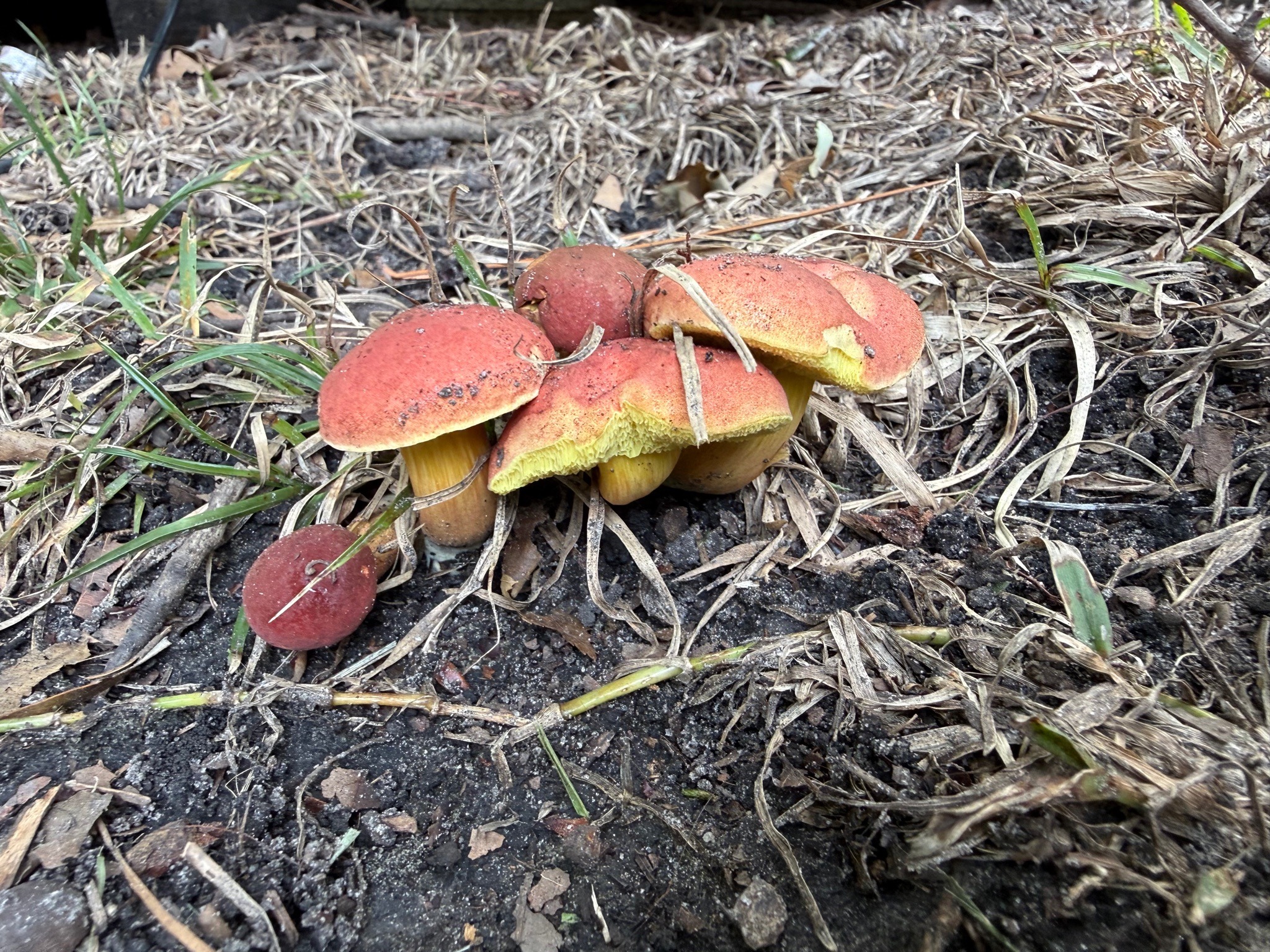
Community find
Bicolor Bolete
Baorangia bicolor
- Group
- bolete
- Spore print
- Olive-brown
- Size
- Cap diameter ranges from 5 to 15 cm; stipe length 5 to 10 cm and width 1 to 3 cm.
- Season
- Typically fruits from early summer through autumn (June to October).
- Habitat
- Commonly found growing on the ground in deciduous forests, particularly associated with oak trees.
- Distribution
- Widely distributed throughout eastern North America, from Canada south to Florida and west to the Great Plains.
- Key characteristics
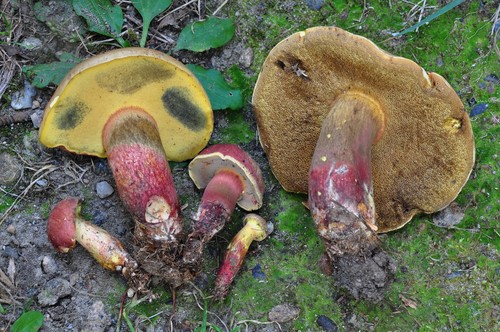
- Features a brick-red to rose-pink cap with a yellow pore surface that stains blue slowly or not at all when bruised. The stem is yellow at the top and reddish towards the base.
- Fruiting body
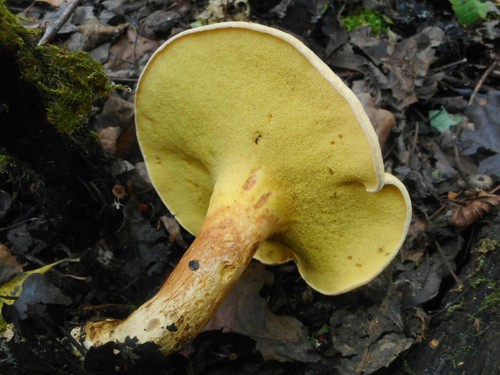
- Cap is convex to broadly convex, dry, finely velvety when young, becoming smoother; color ranges from deep red to pinkish-red. The hymenophore consists of yellow pores that are fairly small. The stipe is solid, thick, yellow at the apex and reddish elsewhere, often with a slightly club-shaped base.
- How to recognise it
- Look for the contrasting red cap and yellow pores, the characteristic yellow/red bicolor stem, and the relatively slow, faint blue bruising reaction on the yellow pore surface compared to more reactive lookalikes.
- Look-alikes
- Hortiboletus campestris (smaller, different bruising), Boletus sensibilis (stains blue instantly and intensely), and various members of the Butyriboletus genus.
- Ecological role
- Mycorrhizal, forming a symbiotic relationship with the root systems of hardwood trees like oaks.
- Notes
- This species was previously classified in the genus Boletus before being moved to Baorangia based on molecular phylogenetic studies. It is one of the most common red-and-yellow boletes in eastern North American forests.