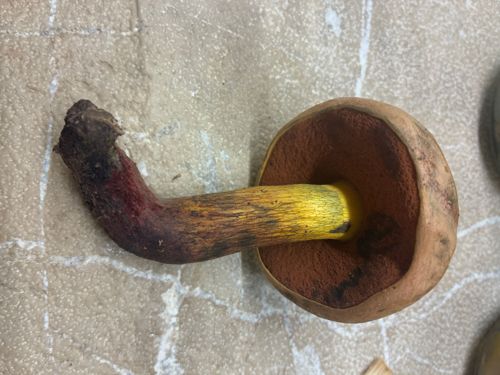
Community find
Bicolor Bolete
Baorangia bicolor (formerly Boletus bicolor)
- Group
- Boletus (Pored mushroom)
- Season
- Summer and fall, often appearing after rainfall.
- Habitat
- Typically found growing scattered or in groups on the ground in deciduous or mixed woods, often associated with oaks. It is a mycorrhizal fungus.
- Key characteristics
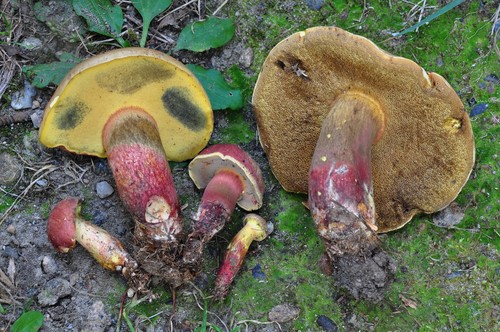
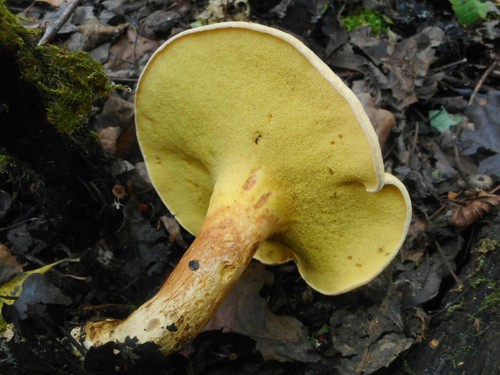
- Cap is typically 5-15 cm wide, convex to broadly convex, dry, unpolished, and can range in color from pinkish-red to brick red, often fading with age. The flesh is pale yellow and usually bruises blue, sometimes slowly and subtly, or not at all. Pores on the underside of the cap are small, circular to angular, and yellow, bruising blue when handled. The stem is solid, 5-12 cm long and 1-3 cm thick, typically yellowish above and reddish below, often tapering towards the base. It can also bruise blue, especially where red meets yellow.
- Look-alikes
- Other red-capped, yellow-pored boletes, such as Boletus sensibilis (which bruises very quickly and intensely blue, and has a more robust stature) or Boletus miniato-olivaceus (which tends to have a more orange-red cap and olive-yellow pores). It can be confused with other red-capped Boletes that do not bruise blue, or those that bruise very little, making careful observation of the bluing reaction essential.
- Ecological role
- Mycorrhizal, forming a symbiotic relationship with trees (especially oaks) by exchanging nutrients. It plays a vital role in nutrient cycling in forest ecosystems, helping trees absorb water and minerals from the soil while receiving sugars in return.