Community find
Bicolor Bolete
Baorangia bicolor
- Group
- Bolete
- Season
- It is typically found from summer to early autumn, particularly after periods of rain.
- Habitat
- The Bicolor Bolete is mycorrhizal, forming symbiotic relationships with oak trees. It is usually found growing terrestrially, solitary or scattered, in deciduous or mixed hardwood forests, especially under oaks.
- Key characteristics
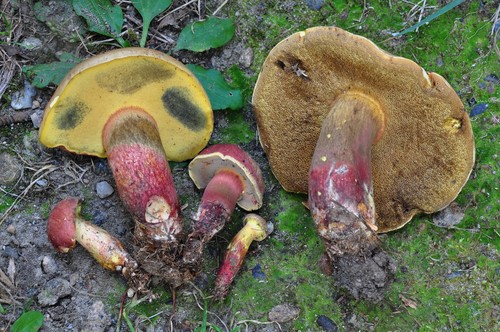
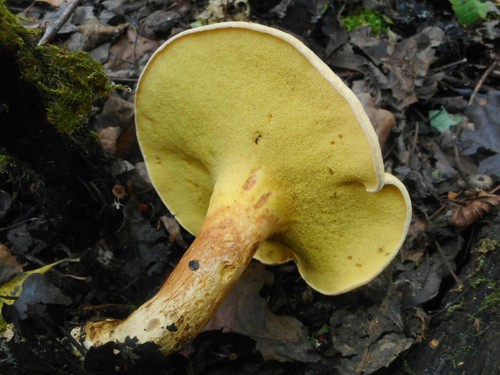
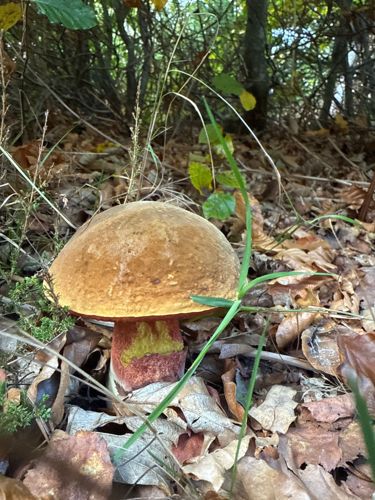
- The cap of the Bicolor Bolete is typically 5-15 cm (2-6 inches) in diameter, convex to broadly convex, and often velvety or finely tomentose, sometimes becoming smooth with age. It is typically a rose-red, cherry-red, or brick-red color, fading to pinkish or reddish-brown in maturity. The pore surface is bright yellow, turning blue instantly when bruised. The pores are small and circular. The stem is usually 4-12 cm (1.5-5 inches) long and 1-3 cm (0.4-1.2 inches) thick, solid, and yellow at the apex, transitioning to red or reddish-pink towards the base. The flesh is yellow and typically stains blue when cut, though staining can vary in intensity. The spore print is olive-brown.
- Look-alikes
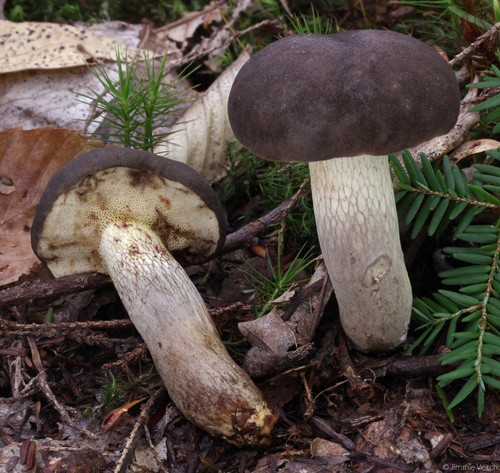
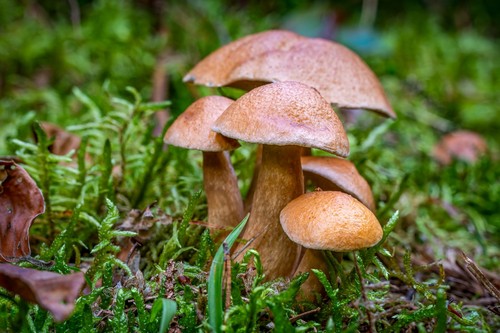
- Several boletes can appear similar. 'Boletus' sensibilis is another red-capped, yellow-pored bolete that stains blue, but it tends to have a more prominent overall blue staining reaction and often a distinct odor. Boletus rubroflammeus is a large, brilliantly colored species with a more intensely red cap and a red or reticulated stipe. Some varieties or forms of Baorangia bicolor may show less pronounced blue staining, making identification more challenging. Always observe multiple characteristics for accurate identification.
- Ecological role
- As a mycorrhizal fungus, Baorangia bicolor forms a mutually beneficial relationship with the roots of oak trees. The fungus extends the root system's reach, aiding the tree in water and nutrient absorption (especially phosphorus and nitrogen). In return, the tree supplies the fungus with carbohydrates produced through photosynthesis. This symbiotic relationship is crucial for the health and growth of the host trees and the overall forest ecosystem. It also contributes to nutrient cycling by breaking down organic matter in the soil.