
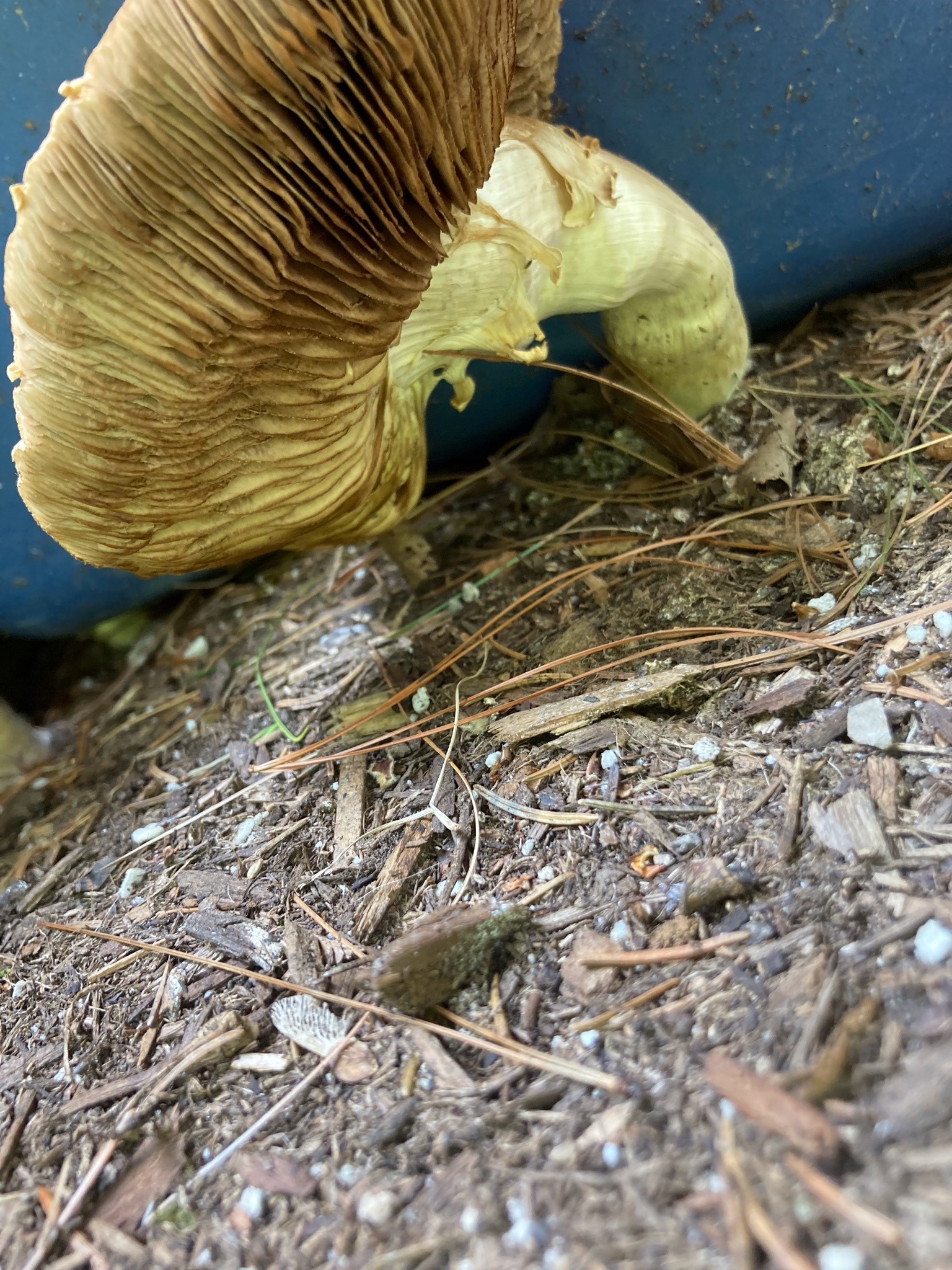
Community find
Big Laughing Gym
Gymnopilus junonius
- Group
- gilled mushroom
- Spore print
- Rusty orange to rusty brown.
- Size
- Cap: 5-20cm diameter; Stipe: 8-20cm long, 1-5cm thick.
- Season
- Typically fruits in summer and autumn (late spring in warmer climates).
- Habitat
- Grows in clusters on living and dead wood, or on buried stumps and roots of both hardwoods and conifers.
- Distribution
- Widely distributed across North America, Europe, Asia, and parts of the Southern Hemisphere.
- Key characteristics
- Large, sturdy, orange to yellow-brown cap with fine scales. Broad, yellow-orange gills and a thick stipe with a distinct ring. Generally bitter taste.
- Fruiting body
- Cap is convex to flat, 5-20cm, yellow to orange with small scales. Gills are yellow, turning rusty brown with age. Stipe is 8-20cm long, often swollen in the middle, with a persistent membranous ring.
- How to recognise it
- Check for the rusty orange spore print, the bitter taste of the flesh (spit out), and the cluster growth on wood with a clear ring on the stipe.
- Look-alikes
- Gymnopilus ventricosus (lacks bitterness, larger), Armillaria species (have white spore prints), Galerina marginata (much smaller, darker spore print, different ring).
- Ecological role
- Saprophytic, breaking down wood and decaying tree stumps.
- Notes
- This species is part of a complex of similar-looking fungi and was historically named Pholiota spectabilis. It is often studied for its ability to produce enzymes that decompose lignin.