Spectacular Rustgill
Gymnopilus junonius
Also called giant gymnopilus, spectacular gymnopilus
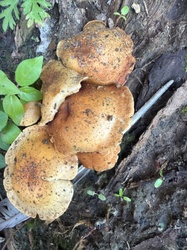
A big, showy orange-tawny agaric that fruits in massive clusters at the base of broadleaf stumps, with a fibrillose scaly cap, ringed stipe and rusty orange spore print.
Overview
The Spectacular Rustgill is the largest and most conspicuous member of Gymnopilus in temperate regions, a genus of wood-rotting agarics characterised by warm orange to tawny colours, rusty spore deposits and a fibrous, dry flesh. It has long been known under the name Gymnopilus spectabilis in European literature, but G. junonius is the currently accepted binomial for the European and widely distributed taxon.
What makes it hard to overlook is sheer bulk. Fruit bodies emerge in tightly packed tufts from a common base, and a single colony at the foot of an old oak or ash stump can carry dozens of caps, sometimes forming a mound half a metre across. The glowing golden to foxy-orange colouring holds even in dull weather, and mature clusters become dusted a deeper rust as spores settle on the caps and rings below them.
Within the fungal world it sits with the heart-rot fungi of standing and fallen broadleaf trees. It occupies a niche between saprotrophy and weak parasitism, colonising damaged heartwood in living trees as well as fruiting from long-dead stumps and buried roots.
How to identify it
Cap
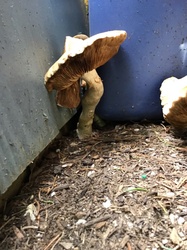
Large, commonly 5-15 cm across and occasionally reaching 20 cm, at first hemispherical with a strongly inrolled margin, later broadly convex to flat. The colour is a rich golden-yellow, tawny or bright foxy orange, sometimes with a rustier centre. The surface is dry and covered in fine appressed fibrillose scales that give a silky, streaked or minutely tufted texture; it is never slimy.
Gills
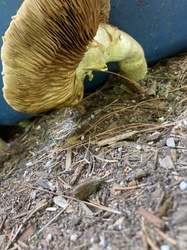
Crowded, narrowly adnate or notched, often running down the stipe as a slight decurrent tooth. Young gills are pale yellow to buttery yellow, darkening through ochre to a deep rusty orange-brown as spores mature. Fallen spores dust the ring and any caps below with a rusty bloom.
Stipe
Stout and firm, 5-15 cm long and up to 3 cm thick, typically club-shaped or swollen in the middle and tapering towards a fused, root-like base where the whole cluster joins. It is yellowish-tan, longitudinally fibrillose, and carries a well-formed membranous ring in the upper third that quickly becomes coated in rust-coloured spores. Several stipes usually spring together from a common woody mass.
Flesh & spore print
The flesh is firm, pale yellow to buff, thick in the cap centre, and does not blue or redden on cutting, though it may dull to brownish with age. The spore print is a distinctive rusty orange-brown. Microscopically the spores are warty and lack a germ pore, which separates Gymnopilus from superficially similar rusty-spored genera.
Where and when it grows
This species fruits at or near ground level on broadleaf trees, forming dense tufts on stumps, at the base of living or dying trunks, over buried roots and around old sawn stools. Oak, ash, beech, sycamore, poplar and fruit trees are all frequent hosts, and clusters occasionally appear on conifer stumps. Because it exploits buried roots, tufts sometimes seem to rise straight out of lawn or path edges several metres from the nearest visible trunk.
The main fruiting period runs from late summer through autumn, often continuing into early winter in mild seasons, and the same stump will usually produce clusters year after year until the wood is exhausted. It is widespread throughout Europe, common in parkland, hedgerows, gardens and mixed woodland, and closely related or conspecific populations occur in North America, East Asia and Australasia.
Ecological role
Gymnopilus junonius is a wood-decay fungus that behaves both as a saprotroph on dead stumps and as a weak parasite of the heartwood of living trees. It causes a white rot, degrading lignin along with cellulose and leaving affected timber pale, soft and fibrous. Infection typically begins at wounds, pruning cuts or root damage, after which the mycelium spreads slowly through the central column of the trunk.
Because it hollows heartwood while the outer sapwood remains functional, colonised trees may live for many years, and the cavities it creates become nesting and roosting sites for birds, bats and invertebrates. The massive clustered fruit bodies release enormous quantities of rusty spores over a few weeks in autumn, and the decayed wood they leave behind is recycled into soil organic matter by later-arriving fungi and invertebrates.
Similar species
Honey fungus (Armillaria mellea and relatives) shares the habit of dense tufts at the base of broadleaf trees and also has a ring, but its cap is honey-yellow to tan with darker erect hairs rather than fibrillose orange scales, its gills stay whitish to cream and become flushed pinkish-brown, and above all it produces a white spore print. Black bootlace rhizomorphs beneath the bark confirm honey fungus.
Sulphur Tuft (Hypholoma fasciculare) is far smaller and slimmer, with greenish-yellow gills, no membranous ring and a purple-brown spore deposit. Gymnopilus penetrans has the same rusty spores but is only a fraction of the size, grows mainly on conifer wood, has a smooth silky cap and no true ring. Pholiota aurivella also produces orange clusters on wood but typically fruits high on trunks in wounds, and its cap is glutinous with flattened gelatinous scales rather than dry and fibrillose.
Common questions about Spectacular Rustgill
How large does this mushroom get?
What separates it from honey fungus?
Does it grow on living trees?
Why do tufts sometimes appear in grass away from trees?
Spectacular Rustgill found by the community
Photos submitted through the app and matched to this entry.