
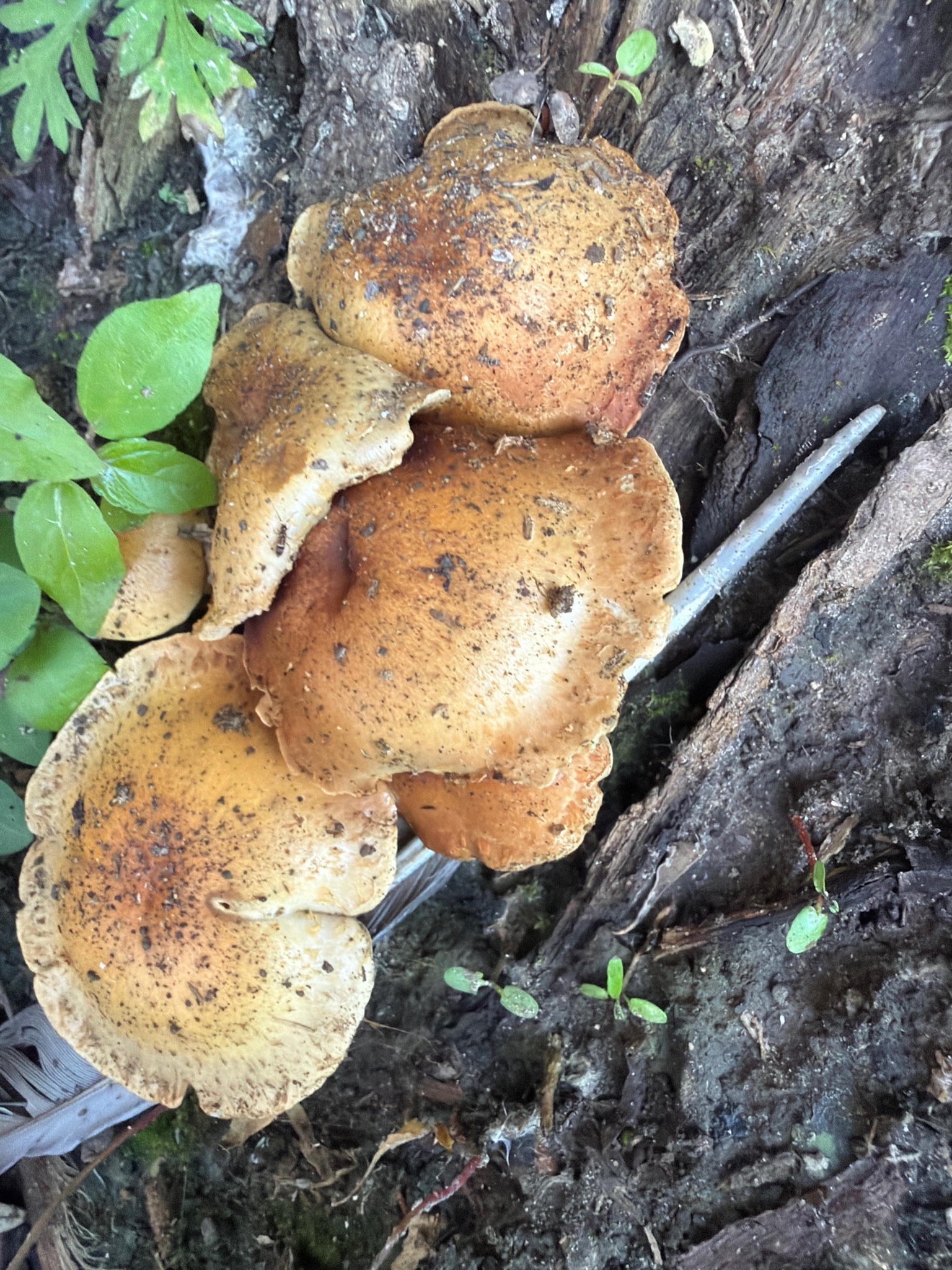
Community find
Big Laughing Gym
Gymnopilus junonius
- Group
- gilled mushroom
- Spore print
- Rusty brown to orange-brown.
- Size
- Cap diameter: 5-20+ cm; Stipe: 5-20 cm long and 1-5 cm thick.
- Season
- Commonly fruits in late summer and autumn, often after heavy rainfall.
- Habitat
- Grows in large clusters (cespitose) at the base of trees, on stumps, or from buried wood. Prefers hardwoods like oak but can be found on conifers.
- Distribution
- Widespread across North America, Europe, Asia, and parts of the Southern Hemisphere including Australia.
- Key characteristics
- Large, fleshy mushroom with orange to orange-brown caps often covered in fine scales. Gills are yellow, turning rusty brown as spores mature. The stem is thick, tough, and usually features a distinct ring.
- Fruiting body
- Cap is convex to flat, 5-25cm wide, dry, and scaly. Gills are adnexed or slightly decurrent, crowded, and change from yellow to rusty orange. The stipe is 5-20cm long, often swollen in the middle or toward the base, with a persistent superior ring.
- How to recognise it
- Look for the large size, clustering growth on wood, the persistent ring on the stem, and the distinctive rusty-brown spore print that often coats the lower caps in a cluster.
- Look-alikes
- Omphalotus illudens (Jack-o’-lantern) lacks the ring and has decurrent gills; Armillaria species (Honey Mushrooms) have a white spore print.
- Ecological role
- Saprophytic, breaking down dead organic matter in wood, and sometimes weakly parasitic on stressed living trees.
- Notes
- The genus name Gymnopilus means 'naked cap.' It is of scientific interest for its chemical composition and complex taxonomy, as it likely represents a species complex rather than a single species.