Community find
Caesar's Mushroom
Amanita caesarea
- Group
- gilled mushroom
- Season
- It is typically found in late summer and autumn, particularly after periods of rain.
- Habitat
- This mushroom is mycorrhizal, forming a symbiotic relationship primarily with broadleaf trees, especially oaks, but also sometimes with conifers. It prefers warm climates and is often found in deciduous or mixed forests, usually on acidic or neutral soils.
- Key characteristics
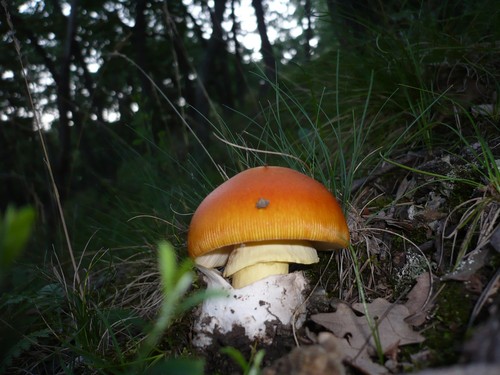
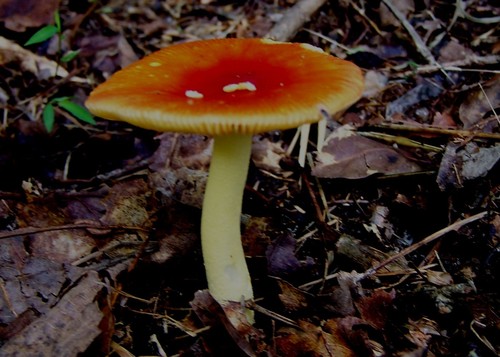
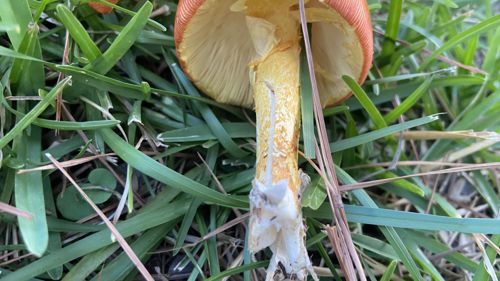
- The Caesar's Mushroom typically features a brilliant orange to red cap, often smooth and sometimes slightly sticky, ranging from 8-20 cm in diameter. The gills are gold-yellow, free from the stem, and crowded. The stem is also gold-yellow, 8-15 cm tall and 2-3 cm thick, with a prominent, skirt-like, yellow ring (annulus) and a large, white, sac-like volva at the base. The spores are white.
- Look-alikes
- Similar looking species include other Amanita species such as Amanita muscaria (which has white gills and a different volva structure, often with warts on the cap) and Amanita jacksonii (which has a redder cap and distinct yellow stripes on the volva). Care must be taken as many Amanita species are deadly poisonous.
- Ecological role
- As a mycorrhizal fungus, Amanita caesarea forms a crucial symbiotic relationship with tree roots, enhancing the tree's ability to absorb water and nutrients from the soil, while the fungus receives carbohydrates from the tree. This interaction contributes to the overall health and nutrient cycling of the forest ecosystem.