Community find
Chaga
Inonotus obliquus
- Group
- polypore
- Spore print
- White to yellowish (rarely observed as spores are produced on the fertile body under bark).
- Size
- Sclerotia can vary from 5cm to over 40cm in diameter, depending on the age and host size.
- Season
- Can be found and harvested year-round, but most visible in winter when deciduous trees lack leaves.
- Habitat
- Primarily grows on birch trees (Betula species), occasionally on other hardwoods like elm or beech. It is found on living trees where the fungus enters through wounds.
- Distribution
- Circumboreal distribution across the Northern Hemisphere, including Russia, Korea, Northern Europe, Northern United States, and Canada.
- Key characteristics
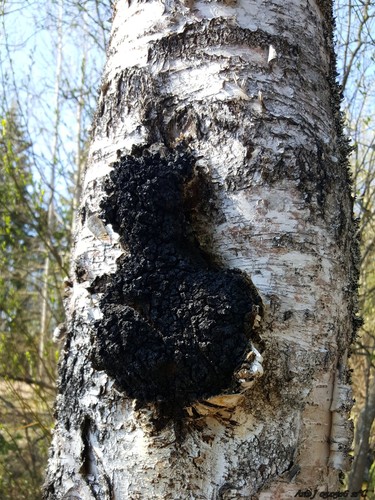
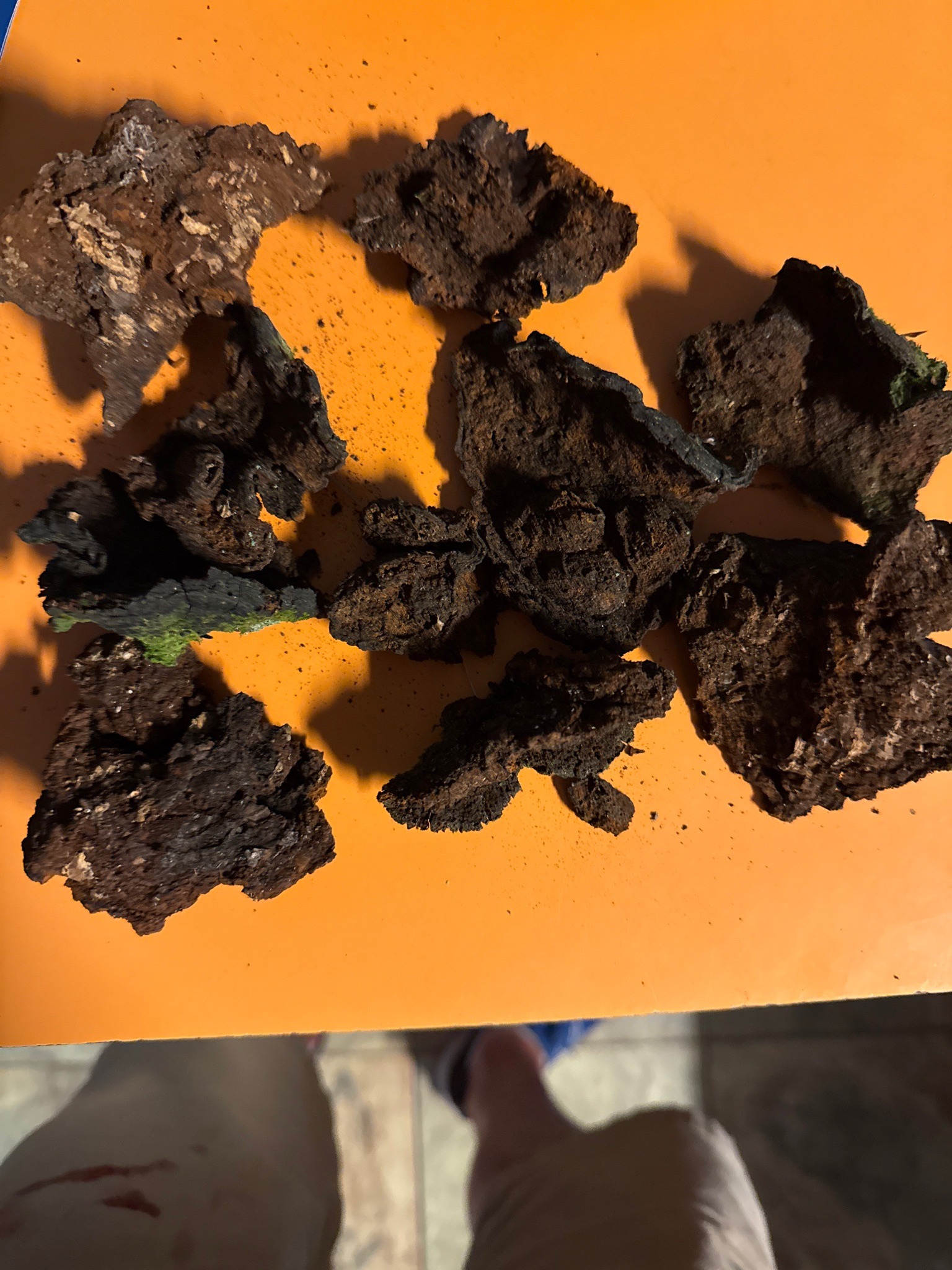
- Rough, blackened, charcoal-like exterior (sclerotium) with a crumbly, rusty-brown or golden-orange interior. It appears as an amorphous growth rather than a typical mushroom shape.
- Fruiting body
- The visible part is a sterile sclerotium, a dense mass of mycelium. It is cracked, hard, and black due to high melanin content. The true fruiting body (fertile part) is rare and grows under the bark once the tree has died.
- How to recognise it
- Look for a burnt charcoal-like texture on the outside and a bright orange-brown corky interior. It always grows on birch in its most recognizable form.
- Look-alikes
- Burls (tree growths without the blackened charcoal texture) and Black Knot fungus (Apiosporina morbosa, typically found on cherry or plum trees).
- Ecological role
- Parasitic on living trees, eventually causing white rot, and becomes saprophytic after the host tree dies.
- Notes
- The blackened exterior is caused by a high concentration of melanin. It has been used historically in various cultures for fire-starting due to its ability to hold a slow-burning ember.