Chaga
Inonotus obliquus
Also called clinker polypore, birch canker polypore, cinder conk
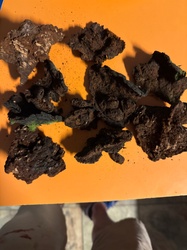
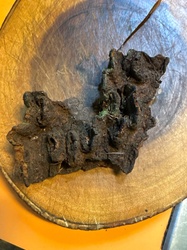
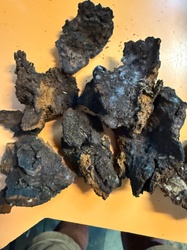
A black, deeply cracked sterile mass that erupts from living birch trunks like a lump of charcoal, revealing bright rusty-orange interior tissue when broken.
Overview
Chaga is unusual among well-known fungi because the structure people recognise is not a fruiting body at all. The black, fissured lump bulging from a birch trunk is a sterile conk — a hard mass of fungal tissue mixed with wood fragments that the fungus pushes out through the bark. The true fruiting body is a thin, brown, poroid crust that forms secretly beneath loosened bark, usually only after the host tree has died, and is rarely seen.
The fungus belongs to Inonotus, a genus of brown-fleshed polypores in the Hymenochaetaceae, a family characterised by rusty-brown tissue that darkens in alkali. The distinctive charcoal-black exterior of the sterile conk is a mass of very thick-walled, dark hyphae, while the interior stays a warm rusty orange-brown with a corky, granular texture and a marbling of paler veins.
Because of its striking appearance and northern distribution, Chaga is one of the easiest fungi to recognise on sight — very little else looks like a burnt cinder growing out of an otherwise unblemished white birch.
How to identify it
Fruiting structure
The visible conk is an irregular, roughly hemispherical to elongated mass, 5–40 cm across, erupting through the bark of a living trunk and often flanked by torn, upturned bark edges. It is rock-hard and its surface is deep black, deeply cracked and fissured into an irregular, clinker-like or charcoal-like pattern with sharp angular ridges. There is no cap, stem, gill or visible pore surface on the sterile conk.
Interior
Breaking or cutting a conk reveals the key character: the inner tissue is bright rusty orange-brown to yellow-brown, corky and granular, marbled with fine cream to white veins, and often studded with embedded fragments of birch wood. The abrupt contrast between the black exterior crust and the vivid ochre interior is diagnostic and no look-alike growth reproduces it.
True fruiting body & spore print
The fertile stage is a resupinate poroid layer, brown and 1–10 mm thick, developing flat against the wood under the bark of a dead or dying host and lifting the bark away in plates. Its tubes are angular and oblique, giving the species its epithet. Spores are pale brown, broadly ellipsoid and smooth, and the setae of the hymenium are dark and hooked under a microscope.
Where and when it grows
Chaga is a fungus of cold-climate birch forest. It grows on living birch (Betula species), most often on mature standing trunks, and less commonly on alder, beech, hornbeam and elm. Conks appear where the fungus has entered through a wound, and a single tree may bear several at different heights.
Its range is circumboreal, spanning northern and montane Europe, Scandinavia, the Baltic and Russia, Siberia, northern China, Korea, Japan, Canada and the northern United States. It becomes markedly less common toward the southern edge of birch's range. Because the conk is a perennial structure it can be found in any month, growing slowly and enlarging over many years.
Ecological role
Inonotus obliquus is a white-rot heart-rot pathogen. It colonises the heartwood of a living birch, degrading lignin and cellulose over a period that can run to a decade or more, while the sterile conk on the outside serves as a long-lived reservoir of mycelium. The infected tree gradually weakens and the decayed stem eventually snaps or dies standing.
The fungus completes its life cycle largely out of sight: only after the host dies does it produce the thin poroid fertile layer beneath the bark, releasing spores that infect wounds on other trees. Ecologically it is an important agent of natural thinning in dense birch stands, converting living trunks into standing deadwood and hollow snags that in turn support cavity-nesting birds and wood-boring invertebrates.
Similar species
The commonest confusion is with burls and cankers — non-fungal woody swellings on birch trunks. These are covered in continuous, if distorted, bark and are solid pale wood inside, with none of the black clinker crust or rusty-orange granular interior of a Chaga conk. Black knot (Apiosporina morbosa) forms similar-looking black cracked swellings but encircles twigs and small branches of cherry and plum, never birch trunks, and is uniformly dark inside.
Other Hymenochaetaceae on birch, such as Inonotus rheades or Willow Bracket (Phellinus igniarius), form proper shelf- or hoof-shaped brackets with a visible pore surface underneath, rather than a shapeless sterile mass with no pores. Old, blackened, weather-beaten Phellinus conks can approach the colour of Chaga from a distance, but they retain a flattened bracket profile and a brown poroid underside.
Common questions about Chaga
Why does Chaga not look like a normal mushroom?
What is the quickest way to confirm it in the field?
Which trees and regions does it favour?
How does it affect the host tree?
Guides
Chaga found by the community
Photos submitted through the app and matched to this entry.