Community find
Chanterelle
Cantharellus cibarius
- Group
- gilled mushroom
- Season
- Generally found in summer and fall, often appearing after periods of rain.
- Habitat
- Chanterelles are mycorrhizal, forming symbiotic relationships with certain trees, typically hardwoods such as oak, beech, and birch, but also conifers in some regions. They generally grow on the ground in mossy areas or leaf litter in mature forests.
- Key characteristics
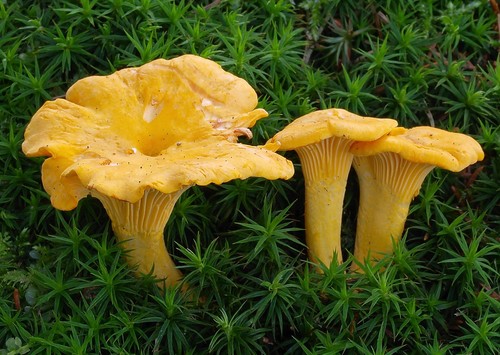
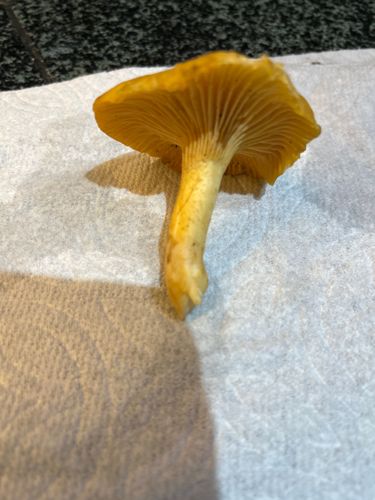
- The cap of a Chanterelle is typically orange or yellow, funnel-shaped or irregularly lobed, with a wavy margin. The underside features gill-like folds or ridges that are decurrent (run down the stem) and are the same color as, or slightly lighter than, the cap. These folds are not true gills but rather blunt, vein-like ridges. The stem is solid, tapering towards the base, and also often yellow or orange. Spore print is pale yellow to white. Size can vary, with caps ranging from 2-10 cm across.
- Look-alikes
- The False Chanterelle (Hygrophoropsis aurantiaca) has true, thin, forked gills and typically grows on wood. The Jack O'Lantern mushroom (Omphalotus illudens) has true, sharp, non-decurrent gills and usually grows in dense clusters at the base of trees or on buried wood. The Woolly Chanterelle (Turbinellus floccosus), while also funnel-shaped, is scaly and often has a more reddish-orange color with distinct gill-like ridges.
- Ecological role
- Chanterelles are mycorrhizal fungi, meaning they form a symbiotic relationship with tree roots. The fungi help the trees absorb water and nutrients from the soil, particularly phosphorus and nitrogen, while the trees provide the fungi with carbohydrates produced through photosynthesis. This mutualistic relationship is vital for the health and growth of many forest ecosystems.