Community find
Chanterelle
Cantharellus cibarius
- Group
- Gilled mushroom (though gills are more like blunt ridges)
- Season
- Generally found from summer through fall, often after good rainfall.
- Habitat
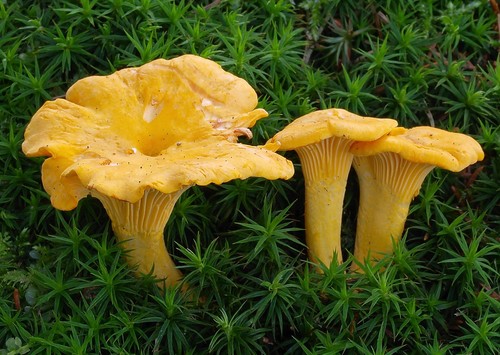
- Chanterelles are mycorrhizal, forming a symbiotic relationship with the roots of various trees, especially oaks, conifers, and beech. They are typically found on the ground in mossy areas of deciduous and coniferous forests.
- Key characteristics
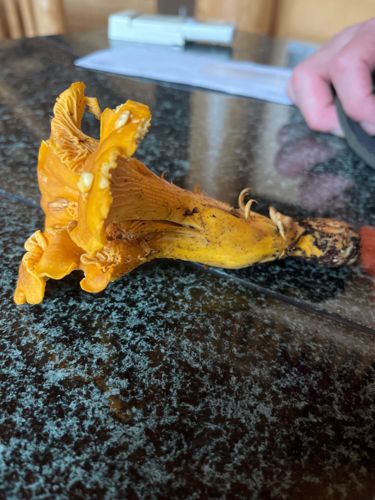
- The cap is typically 2-10 cm wide, golden-yellow to egg-yolk yellow, often wavy, irregular, or funnel-shaped with an inrolled margin when young. The underside has blunt, fold-like ridges that run down the stipe, not true gills. The stipe (stem) is usually solid, tapers downwards, and is the same color as the cap. The flesh is firm and whitish to pale yellow.
- Look-alikes
- False Chanterelle (Hygrophoropsis aurantiaca) has true, distinct gills that are more orange. Jack O'Lantern mushroom (Omphalotus illudens) grows in dense clusters on wood, has true gills, and is often much larger and brighter orange. Cinnabar-red Chanterelle (Cantharellus cinnabarinus) is smaller and distinctly red. Smooth Chanterelle (Cantharellus lateritius) has a very smooth underside with no ridges or gills.
- Ecological role
- Mycorrhizal, forming a symbiotic relationship with trees where the fungus aids the tree in nutrient uptake (especially water and minerals) and in return receives carbohydrates produced by the tree through photosynthesis. This relationship is crucial for the health of many forest ecosystems.