Community find
False Turkey Tail
Stereum ostrea
- Group
- crust fungus / polypore-like
- Spore print
- White
- Size
- Cap diameter 1-7 cm; thickness 0.5-1.5 mm.
- Season
- Year-round, though it fruits most vigorously in late summer and fall.
- Habitat
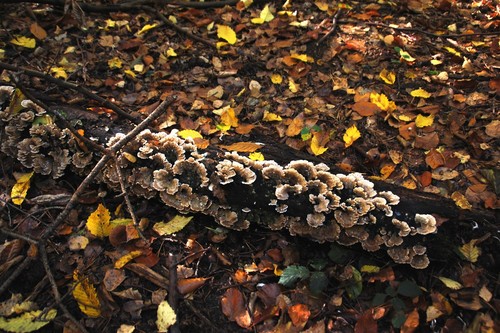
- Grows on dead hardwood logs and stumps, particularly oak. It is a wood-decay fungus.
- Distribution
- Widely distributed across North America and found in many temperate regions globally.
- Key characteristics
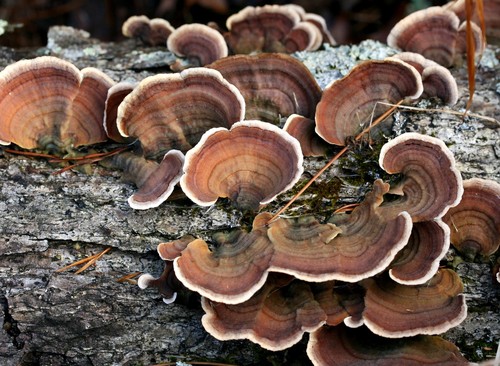
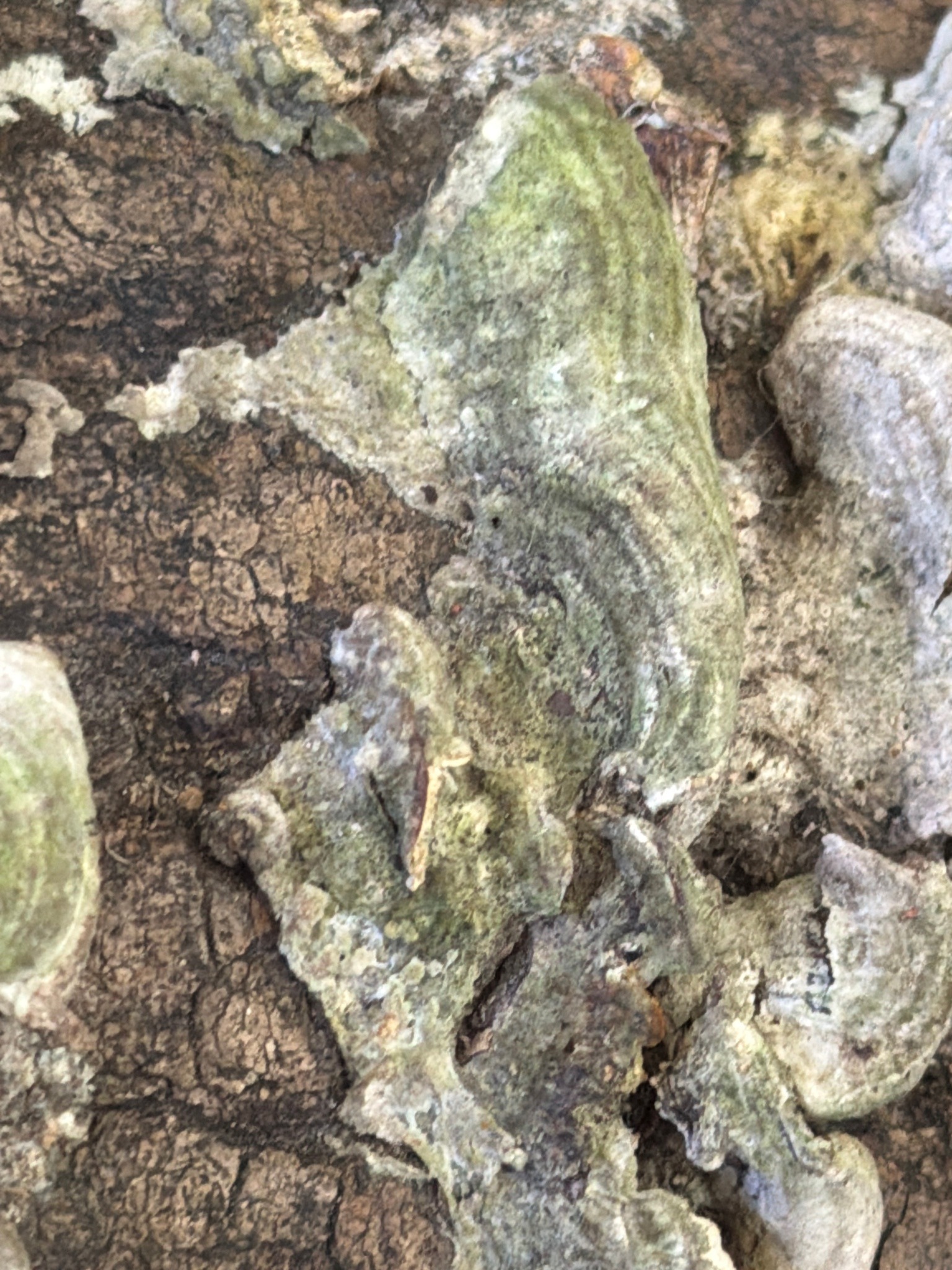
- Thin, fan-shaped brackets often appearing in overlapping clusters. The upper surface is velvety with concentric zones of various colors (brown, beige, grey), commonly stained green by algae. The underside is smooth, lacking pores.
- Fruiting body
- Sessile (attached directly to wood), leathery, fan-shaped or semicircular brackets. Cap is zonate with multi-colored bands and a wavy margin. The hymenium (underside) is smooth, buff to light cinnamon-brown, and devoid of pores or teeth.
- How to recognise it
- Check the underside; if it is smooth and lacks visible pores, it is a Stereum species. The large, fan-like shape and algal greening are diagnostic for S. ostrea.
- Look-alikes
- Trametes versicolor (True Turkey Tail) which has a porous underside; Stereum hirsutum which is smaller and more hairy/yellow.
- Ecological role
- Saprophytic, breaking down lignin and cellulose in dead hardwood trees, causing white rot.
- Notes
- The common name 'False Turkey Tail' refers to its resemblance to the True Turkey Tail (Trametes versicolor). The green tint often seen on older specimens is due to a symbiotic relationship with green algae growing within the velvety hairs of the cap.