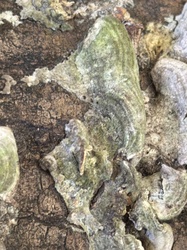
False Turkey Tail
Stereum ostrea
Also called golden curtain crust, oyster stereum
A thin, fan-shaped bracket banded in tan, orange and brown that mimics the true Turkey Tail from above but has a completely smooth, poreless underside.
Overview
False Turkey Tail is a member of Stereum, a genus of crust and bracket fungi whose defining feature is a smooth spore-bearing surface with no pores, gills or teeth at all. Rather than folding its fertile layer into tubes to gain surface area, Stereum simply spreads it flat across the underside of the fan, which is why the underside looks blank and papery when compared with a true polypore.
The species is best known for the confusion it causes with Trametes versicolor, the true Turkey Tail, which it matches closely in shape, size and zoning from above. The name ostrea refers to the oyster-shell outline of the fan. In practice the name has been applied to several closely related zoned Stereum species around the world, and material from North America and Europe is often better placed with relatives such as Stereum lobatum, Stereum subtomentosum or Stereum hirsutum.
It is one of the most abundant wood-decay fungi of hardwood forest, forming overlapping tiers along the length of a fallen log and persisting through the year in a dried, faded state.
How to identify it
Fruiting body
Brackets are 2-8 cm wide, thin and leathery, fan-shaped to semicircular or shell-like, and narrowed to a small point of attachment. They grow singly, in overlapping tiers, or fused side by side into long undulating rows. The margin is thin, often wavy or lobed, and typically paler — whitish to cream — than the rest of the fan.
Upper surface
The upper surface is finely velvety to silky when fresh, becoming smoother and duller with age, and is marked with concentric zones in tan, ochre, cinnamon, orange-brown and greyish bands. Older specimens frequently carry a green film of algae, which mutes the pattern considerably.
Underside
This is the decisive character: the underside is entirely smooth to very finely wrinkled, with no pores, tubes, gills or teeth visible even under a hand lens. It is cream, buff or pale tan when fresh, ageing to a dull ochre or greyish brown.
Flesh & spore print
The flesh is thin, tough and pliable when damp, becoming rigid and brittle when dry, and does not readily rehydrate to full flexibility. The spore print is white. Some close relatives in the genus release a reddish juice from cut fresh flesh, though this species typically does not.
Where and when it grows
It fruits on dead hardwood — fallen trunks, standing dead stems, stumps and thick branches — with oak, beech, maple, birch and hickory among the frequent hosts. It favours logs that have lost their bark in patches, colonising the exposed wood surface and spreading in long overlapping bands.
The genus is cosmopolitan, and zoned Stereum brackets of this type occur across North America, Europe, Asia and Australasia. Fruit bodies are present year-round because the tough tissue survives drying and freezing, but new growth and spore release peak from late summer through autumn.
Ecological role
False Turkey Tail is a saprotroph causing a white rot, degrading lignin along with cellulose and bleaching the wood to a pale, fibrous, stringy mass. It is an early to mid-stage coloniser of hardwood, often arriving soon after the branch falls and holding the substrate for several seasons.
Its thin brackets are a familiar micro-habitat in their own right: they host specialised fungicolous fungi such as the small green Tremella and Hypomyces parasites, shelter mites and beetle larvae, and their algal films add a further layer to the deadwood community. By opening up dense hardwood, the species accelerates the return of nutrients to the forest floor.
Similar species
The true Turkey Tail, Trametes versicolor, is the main confusion. Turn the bracket over: Trametes shows a fine white pore surface with roughly 3-5 round pores per millimetre, while Stereum is smooth and blank. Trametes versicolor is also thinner, more flexible when fresh, and usually more strongly contrasted, with dark blue-grey to nearly black zones alternating with pale ones.
Stereum hirsutum is closely allied and has a coarser, distinctly hairy upper surface with brighter yellow-orange tones and a less regular fan outline. Stereum subtomentosum bruises yellowish on the underside where scratched. Trichaptum biforme can look similar from above but has a violet-tinged, ageing-toothed pore surface below. Young Trametes hirsuta is separated by its coarse stiff hairs and white round pores.
Common questions about False Turkey Tail
How do I separate it from true Turkey Tail?
Why do the brackets often look green?
Does it grow on conifers?
What kind of decay does it cause?
Guides
False Turkey Tail found by the community
Photos submitted through the app and matched to this entry.