Community find
Gem-studded Puffball
Lycoperdon perlatum
- Group
- Puffball
- Season
- Typically found from summer to fall, but can appear earlier or later depending on local climate conditions, especially after rainfall.
- Habitat
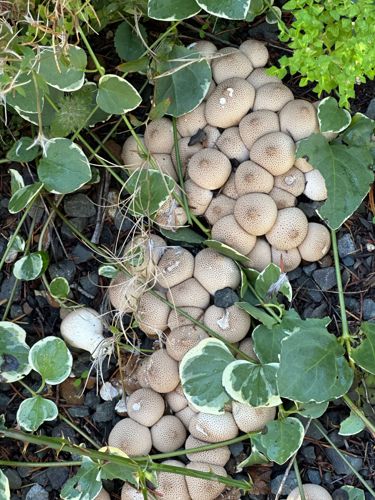
- This puffball is saprobic, growing on the ground in a variety of habitats, including lawns, pastures, woodland edges, and clearings. It often appears on decaying wood or wood chips, either singly or in clusters.
- Key characteristics
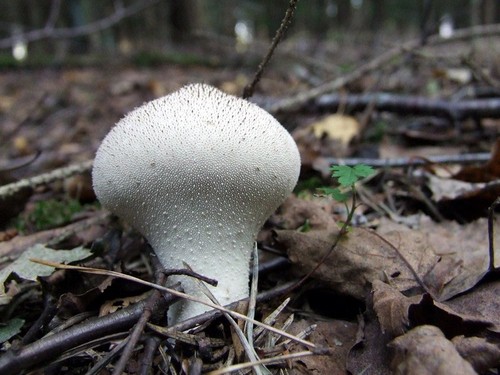
- The fruit body is pear-shaped to spherical and typically measures 2-7 cm in diameter. The surface is white to off-white, and covered with distinctive short, cone-shaped spines (gems) interspersed with smaller granules, which often fall off as the mushroom ages, leaving a reticulate (net-like) scar pattern. The interior (gleba) is white and firm when young, eventually turning yellowish-green and powdery as spores mature. There is a sterile base that is usually present.
- Look-alikes
- Other puffball species such as Lycoperdon pyriforme (Pear-shaped Puffball), which lacks the prominent 'gems' and often has a brownish color, and various Bovista species. It could also sometimes be mistaken for young, unexpanded Amanita "eggs" by inexperienced foragers, which have gills and a developing cap inside.
- Ecological role
- As a saprobic fungus, Lycoperdon perlatum plays a crucial role in nutrient cycling by breaking down dead organic matter, particularly decaying wood and leaf litter, thereby returning essential nutrients to the soil.