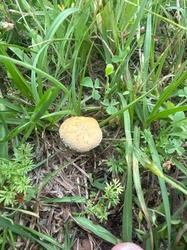
Gem-studded Puffball
Lycoperdon perlatum
Also called common puffball, warted puffball, devil's snuff-box
A small white to buff puffball shaped like an inverted pear, covered in detachable cone-shaped spines that leave a net-like pattern of scars when they fall. It releases spores through a neat apical pore in the top of the head.
Overview
The Gem-studded Puffball is the archetypal small woodland puffball and probably the most frequently encountered Lycoperdon across the northern hemisphere. Its body is divided into a rounded fertile head and a narrower sterile base, giving an inverted-pear or club-shaped silhouette that is instantly familiar once learned.
The common name refers to the covering of short, pointed, detachable spines - the 'gems' - which are interspersed with much smaller granular warts. When the large spines rub off, they leave behind a faint reticulate pattern of pale scars, like a net drawn on the surface, and this scar pattern is one of the most useful confirmation features in the field.
Lycoperdon sits in the family Agaricaceae alongside the true puffballs and the field mushrooms. Like all puffballs it has abandoned forcible spore discharge in favour of an enclosed spore mass released through a pore, a design that works well in sheltered woodland where there is little wind to catch freely falling spores.
How to identify it
Fruiting body
Small to medium, 2-6 cm wide and 3-7 cm tall, shaped like an inverted pear, a club or a spinning top: a rounded fertile head above a distinctly narrowed, wrinkled sterile stalk-like base. Colour is white to cream when young, ageing through buff and ochre to dull brown.
Surface
Densely covered with detachable spines of two sizes - larger conical or pyramidal spines up to about 2 mm long, surrounded by a mosaic of much finer granular warts. The tall spines wear off readily with age or handling, leaving a distinctive network of pale circular scars over a smoother brown surface. This two-tier ornamentation plus reticulate scarring is the key diagnostic combination.
Interior and pore
The head is filled with firm white gleba when young; the narrow base is a spongy sterile tissue that stays paler and never becomes powdery in the same way. With maturity the gleba turns yellowish, then olive, then a dry olive-brown to purplish-brown dust. A single neat circular pore opens at the apex of the head, and raindrops or passing animals compress the elastic wall so that puffs of spores are ejected through it.
Spore print
Olive-brown. Spores are spherical and minutely warted.
Where and when it grows
It grows on the ground in woodland of all kinds - broadleaf, coniferous and mixed - typically in leaf litter, on humus-rich soil, along path edges, on old woodland banks and in mossy clearings. It also appears in grassy woodland margins, plantations, parks and gardens, and occasionally on very rotten buried wood, but it is chiefly a soil-litter species rather than a wood-dweller.
Fruiting bodies appear from summer through to late autumn, often gregariously in scattered troops or dense clusters of a dozen or more, and the brown weathered husks may persist well into winter. The species is widespread and common throughout temperate Europe, North America and Asia.
Ecological role
Lycoperdon perlatum is saprotrophic, its mycelium ramifying through leaf litter and the humus layer of the forest floor, decomposing dead plant material and returning nutrients to the soil. It is one of the many litter-decay fungi that keep woodland floors from accumulating undecayed debris, and it is often abundant on disturbed, compacted ground such as path edges where litter collects.
Spore release is a small feat of engineering: the mature fruiting body acts as a bellows. When a raindrop strikes the flexible upper wall, the sudden pressure expels a visible cloud of spores through the apical pore, a mechanism that spreads spores in short bursts even in the still air beneath a canopy. The sterile base persists after the head has emptied, leaving a hollow brown cup-like remnant recognisable long after fruiting has ended.
Similar species
The Pear-shaped Puffball (Apioperdon pyriforme) is a close relative but grows in dense clusters directly on rotting stumps and logs, is smoother with only fine granular warts rather than tall conical spines, and has conspicuous white mycelial cords at its base. The Meadow Puffball (Lycoperdon pratense, syn. Vascellum pratense) is a squatter grassland species whose fertile head is separated from the sterile base by a distinct internal membrane visible in section, and it leaves a wide shallow cup after weathering.
The Spiny Puffball (Lycoperdon echinatum) is darker, with much longer, curved spines that arch together in groups of three or four and leave a coarser scar pattern behind. Earthballs (Scleroderma) are quite different in construction: no narrowed stalk-like base, no apical pore, a thick tough scaly rind, and an interior that becomes firm and purple-black at an early stage rather than passing through a long white then powdery-brown sequence.
Common questions about Gem-studded Puffball
What are the 'gems' in the name?
How does it release its spores?
Does it grow on wood or on soil?
Why is the base different from the top?
Guides
Gem-studded Puffball found by the community
Photos submitted through the app and matched to this entry.