Community find
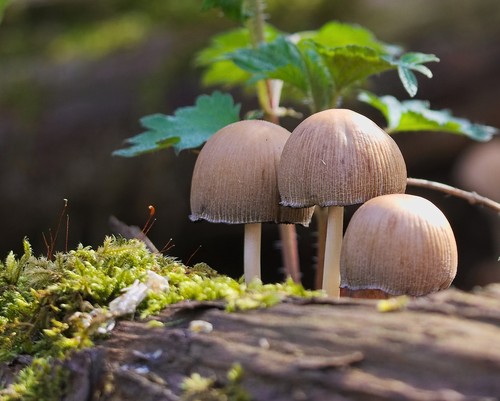
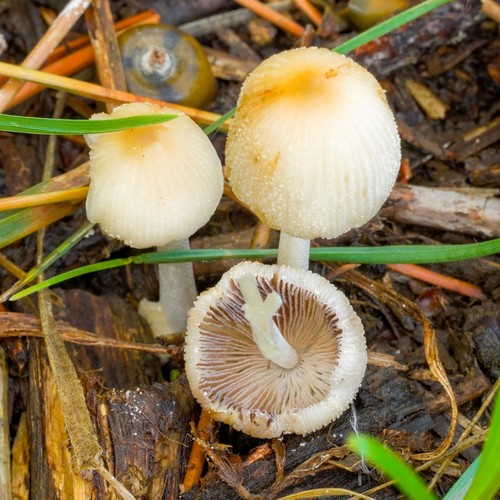
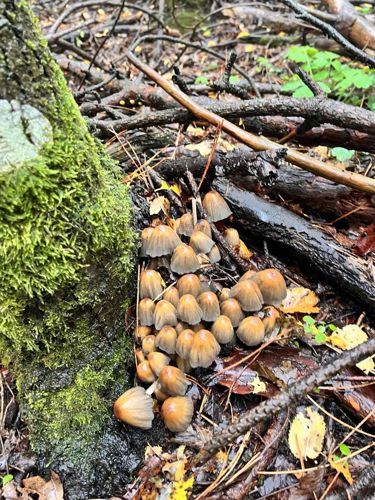
Glistening Inkcap
Coprinellus micaceus
- Group
- gilled mushroom
- Season
- Commonly found from spring through fall, especially after rain, and can sometimes be found in winter during mild periods.
- Habitat
- Typically found in dense clusters on decaying hardwoods, stumps, buried wood, or at the base of living trees. It is a common saprobic mushroom in urban and natural settings.
- Key characteristics
- Caps are initially ovate to bell-shaped, expanding to convex and then plano-convex or almost flat with age, typically 1-4 cm in diameter. The color is brownish to yellowish-brown, often darker towards the center, and typically radially grooved or striate, especially when moist. The surface is often covered with fine, glistening, mica-like particles, which may wash off with rain. Gills are crowded and free, starting whitish, then gray, and eventually black and deliquescing (dissolving into an inky liquid) with age. Stems are slender, whitish, hollow, and fragile, usually 3-10 cm tall and 2-5 mm thick, often with a slightly swollen base. Spore print is black to dark brown.
- Look-alikes
- Several other Coprinellus species can look similar, particularly other inkcaps. Coprinellus truncorum is very similar and often considered conspecific by some; it generally has larger spores. Coprinellus disseminatus (Fairy Inkcap) also grows in clusters but is much smaller and lacks the mica-like particles. Distinguishing features often require microscopic examination, especially to differentiate it from C. truncorum.
- Ecological role
- A saprobic fungus, meaning it obtains nutrients by breaking down dead organic matter, primarily wood. It plays an important role in nutrient cycling in forest ecosystems by decomposing dead trees and woody debris.