Mica Cap
Coprinellus micaceus
Also called glistening inkcap, shiny cap, mica inkcap
A small tawny-honey inkcap with a deeply grooved cap sparkling with mica-like granules when fresh, fruiting in dense clusters at the base of hardwood stumps.
Overview
Coprinellus micaceus is among the most abundant small inkcaps of temperate woodland and urban parkland. It belongs to Coprinellus, one of the segregate genera created when the old catch-all Coprinus was divided; Coprinellus species are typically small, tawny to ochre, deeply grooved, and only partially deliquescent, dissolving less completely than the larger grey inkcaps.
The common name refers to the fine, glistening, colourless to whitish granules that coat the young cap and catch the light like flakes of mica. These are cells of the universal veil, and they are easily washed off by rain or rubbed away by handling, so older or weathered fruiting bodies lose the feature entirely and become much harder to place.
The species is functionally almost inseparable in the field from Coprinellus truncorum, a near-identical fungus distinguished chiefly by spore shape and the form of the spore attachment under a microscope. Many field records of one almost certainly include the other, and the pair is often recorded together as an aggregate.
How to identify it
Cap
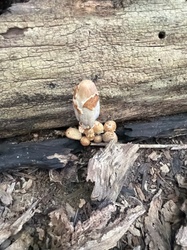
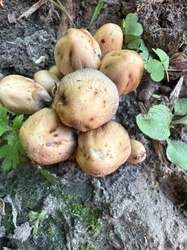
1-4 cm across and up to 3 cm tall, at first an elongated oval or thimble shape, expanding to bell-shaped and finally flattening with an upturned, often split margin. The colour is tawny, honey-brown, ochre-brown or date-brown, distinctly darker toward the centre and paler and greyer toward the edge. The surface is deeply and finely grooved almost to the disc, following the gills beneath, and when fresh it is dusted with tiny glistening mica-like granules, densest at the centre.
Gills
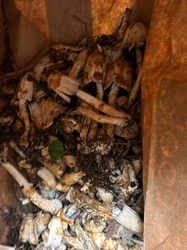
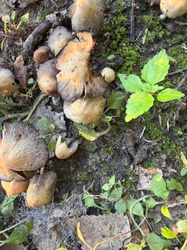
Crowded, narrow, narrowly attached to the stem, white at first, then buff, then brown and finally blackish. Deliquescence is partial: the gills blacken and collapse into a dark slurry but the cap often shrivels and dries rather than dissolving away completely, so a shrunken blackened cap frequently persists on the stem.
Stipe
3-8 cm tall and 2-5 mm thick, white to very pale cream, hollow, fragile, smooth to slightly silky-fibrillose, sometimes with a fine downy coating at the base. There is no ring. The bases of adjacent stems are usually crowded together where the cluster emerges from the wood.
Flesh & spore print
Flesh very thin, pale and fragile, unchanging apart from the natural blackening of the gills. Smell faint. The spore print is dark brown to blackish-brown. Spores are smooth, mitre-shaped to lens-shaped in profile with a central germ pore, and their outline separates this species from Coprinellus truncorum, whose spores are more rounded with an eccentric attachment.
Where and when it grows
Mica Cap is saprotrophic on hardwood, fruiting in dense clusters of dozens to hundreds directly on stumps, at the base of standing dead or damaged broadleaf trees, on fallen logs, and on buried roots. Elm, willow, poplar, maple, beech and oak are among the commonest substrates. Where the wood is buried the clusters appear to be growing out of the soil around the base of a living tree.
It fruits from spring through to late autumn, sometimes into mild winters, and is one of the earliest larger fungi of the season in many regions, often appearing in April and May. It is cosmopolitan, recorded throughout the temperate Northern Hemisphere and widely elsewhere, and is equally at home in ancient woodland and in city parks and gardens.
Ecological role
As a white-rot wood decomposer it breaks down cellulose and lignin in dead hardwood, playing a substantial part in the decay of stumps, root plates and fallen branches. Colonies can persist in a single stump for years, producing repeated flushes each time rainfall and temperature allow, and gradually reducing hard timber to soft crumbly residue that is incorporated into the soil.
The partial deliquescence typical of Coprinellus achieves spore release in a species with a very thin, short-lived cap: the gill tissue self-digests just enough to keep releasing spores from a progressively shrinking hymenium, after which the whole cap dries and shrivels. The fruiting bodies are heavily used by fungus gnats, springtails and beetles, and the abundant clusters make the species an important small-scale resource for woodland invertebrates.
Similar species
Coprinellus truncorum is effectively identical in the field, with the same tawny grooved cap, granular dusting and clustered habit on wood; reliable separation requires examining spore outline and the position of the hilar appendix under a microscope. Fairy Inkcap (Coprinellus disseminatus) grows in far larger troops of much smaller, paler greyish-white to buff fruiting bodies with no glistening granules and a more strongly pleated cap.
Common Ink Cap (Coprinopsis atramentaria) is considerably larger, grey rather than tawny, smooth or finely scaly rather than granular, and dissolves completely into black liquid. Various Psathyrella species share the fragile hollow stem and clustered woodland habit but have smoother, non-granular caps, do not deliquesce at all, and give a purplish-brown rather than blackish spore print.
Common questions about Mica Cap
What are the glistening particles on the cap?
Does the cap fully dissolve like other inkcaps?
Where does it grow?
How is it separated from Fairy Inkcap?
Mica Cap found by the community
Photos submitted through the app and matched to this entry.