
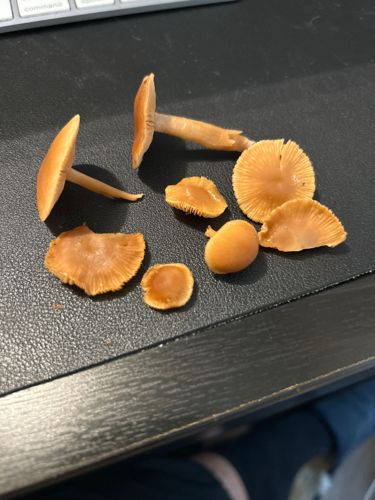
Community find
Gymnopus dryophilus
Gymnopus dryophilus
- Group
- Gilled mushroom
- Season
- Spring through fall, sometimes into early winter in milder climates.
- Habitat
- Saprobic; grows on decaying hardwood and conifer wood, often appearing terrestrial as it grows from buried wood. Found in forests, parks, and disturbed areas, often gregariously or in clusters.
- Key characteristics
- Cap: 1-7 cm in diameter, convex to broadly convex or flat, sometimes with a slight central depression or umbo; color varies from reddish-brown to cinnamon-brown, tan, or buff, fading to paler shades with age, often with a somewhat oily or moist appearance. Gills: attached to notched, crowded, white to cream-colored. Stem: 2-8 cm long, 2-8 mm thick, equal or tapering slightly upwards, hollow or stuffed, pale buff to reddish-brown, often white at the base, sometimes longitudinally grooved. Spore print: white.
- Look-alikes
- Some Marasmius species, though Gymnopus dryophilus generally has more robust stems and a less leathery cap. Collybia peronata (Gingerbread Collybia) has a hairy stem base and a strong peppery taste. Rhodocollybia butyracea (Buttery Collybia) has a greasy cap and stem and a noticeably buttery texture. Gymnopus spongiosus can appear similar but has a spongy stem base and grows specifically in association with pine needles.
- Ecological role
- Decomposer (saprobic), breaking down dead woody material and returning nutrients to the soil. Important in forest ecosystems for nutrient cycling.