Community find
Honey Fungus / Honey Mushroom
Armillaria mellea
- Group
- gilled mushroom
- Season
- Late summer to late autumn, especially after rain.
- Habitat
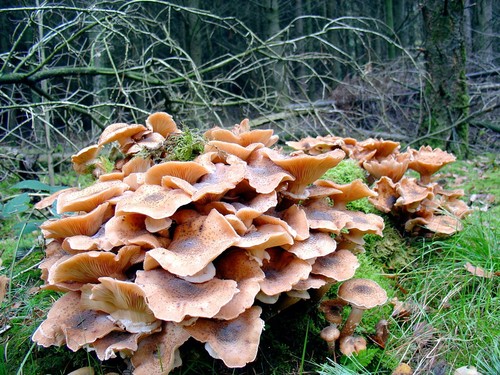
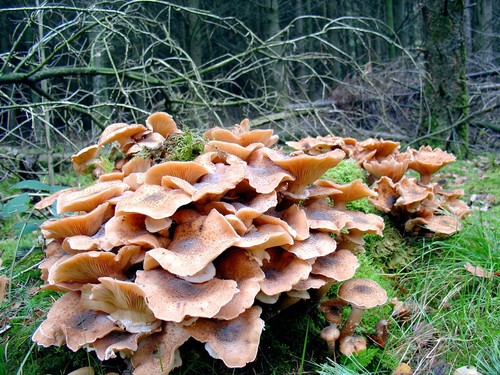
- Found singly, in clusters, or large aggregations on living or dead deciduous and coniferous trees, stumps, and buried wood. It is a parasitic species, causing white rot in wood, but can also be saprophytic.
- Key characteristics
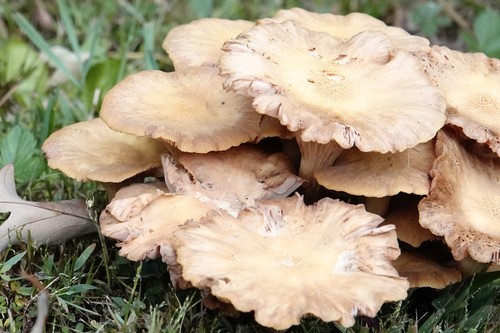
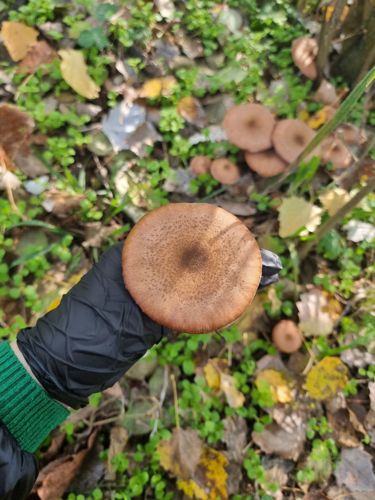
- Cap: Typically 2-15 cm wide, convex to flattened, often with a central uplift (umbo) when young, expanding to flat or slightly depressed with age. Color ranges from yellow-brown to reddish-brown, often darker in the center, and can be covered with small, darker scales, especially when young. Gills: White to yellowish, adnate to slightly decurrent, becoming spotted with age. Stem: 5-20 cm long and 1-3 cm thick, fibrous, often tapering towards the base, with a prominent ring (annulus) that starts white and darkens with age. Spore Print: White to creamy.
- Look-alikes
- Several species of Armillaria look similar, and distinguishing between them can be challenging without microscopic examination or genetic analysis. Galerina marginata (Deadly Galerina) is a deadly toxic mushroom that can resemble younger honey mushrooms and grows on wood. Pholiota species may also be confused, but generally have a more scaly cap and stem.
- Ecological role
- Armillaria mellea is a parasitic fungus that causes 'white rot' disease in trees, leading to the weakening and eventual death of infected hosts. It can infect a wide range of tree species, both coniferous and broadleaf. It is also a saprophyte, breaking down dead wood and recycling nutrients back into the ecosystem.