Community find
Honey Fungus / Honey Mushroom
Armillaria mellea sensu lato
- Group
- Gilled mushroom
- Season
- Late summer to autumn, particularly after periods of rain.
- Habitat
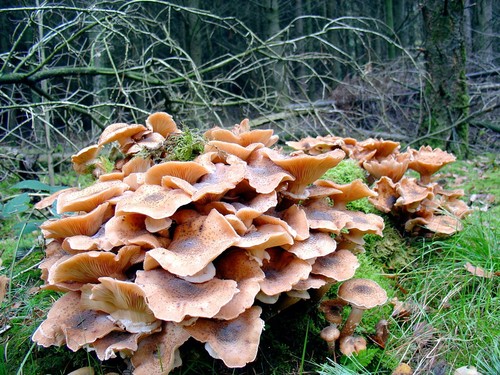
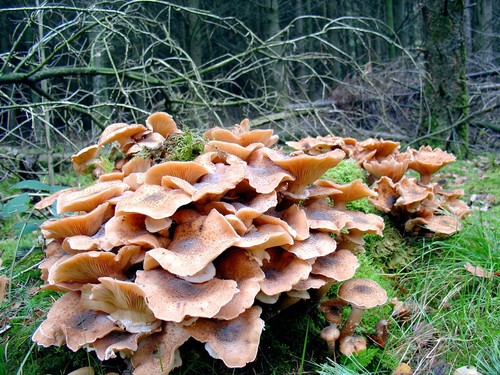
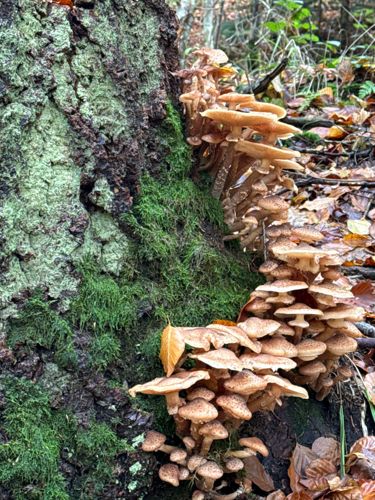
- Typically found growing in dense clusters at the base of trees, on stumps, logs, or buried roots. They are parasitic on living trees, causing white rot, and also saprophytic on dead wood. Widespread in deciduous and coniferous forests.
- Key characteristics
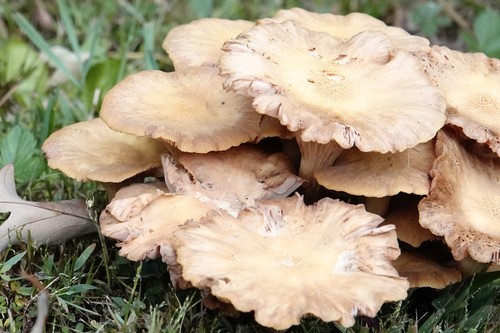
- Caps typically 3-15 cm wide, honey-yellow to brownish, often with small, darker scales, especially when young, flattening with age. Gills are whitish to yellowish, often becoming spotted with age, attached to slightly decurrent. Stems are tough, fibrous, 5-20 cm long and 1-3 cm thick, whitish to brownish, often with a persistent ring (annulus) that can be cottony or membranous. Spore print is white. Often grows in dense clusters.
- Look-alikes
- Several species can resemble honey mushrooms, including Galerina marginata (which is toxic and has a brown spore print, and lacks a prominent ring), Pholiota species (which often have more scaly caps and different gill attachments), and other Armillaria species. Careful identification of the ring, spore print, and growth habit is crucial.
- Ecological role
- Armillaria mellea is both a significant forest pathogen and a decomposer. As a parasite, it causes 'white rot' disease in many species of trees, leading to their decline and death. As a saprophyte, it decomposes dead wood, recycling nutrients back into the ecosystem. It spreads through underground rhizomorphs ('bootlaces').