Community find
Horse Mushroom
Agaricus arvensis
- Group
- gilled mushroom
- Season
- Commonly found from summer through autumn, often after rain.
- Habitat
- It typically grows solitarily or in small groups on the ground in grassy areas, lawns, meadows, parks, gardens, and sometimes in open woodland edges. It often appears in disturbed ground and can be quite common in urban and suburban settings.
- Key characteristics
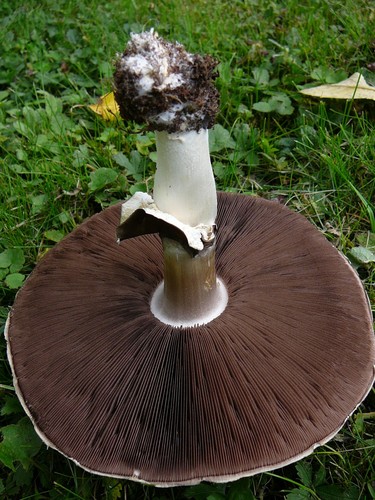
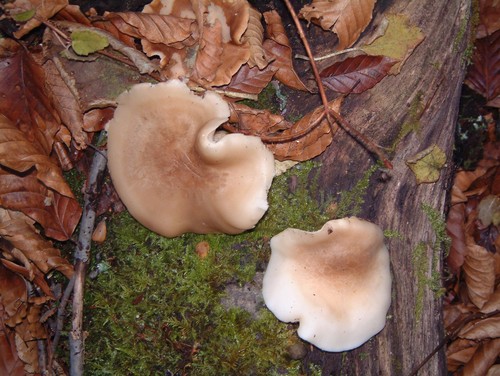
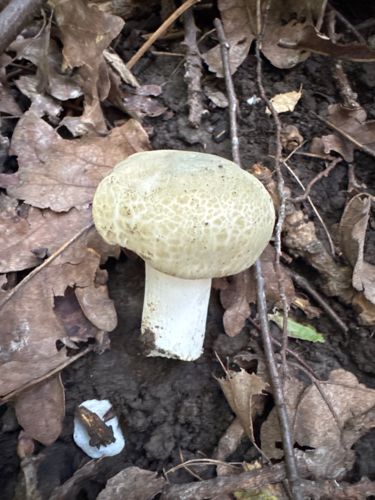
- The Cap is typically 5-15 cm in diameter, convex to broadly convex or nearly flat in age, often with an inrolled margin when young. The color is off-white to pale cream or yellowish, often with darker yellowish-brown to reddish-brown fibrils or scales, especially towards the center. The surface can be dry and appears somewhat cracked or areolate, revealing the paler flesh beneath. The Gills are free from the stem, crowded, and initially white, becoming pinkish to brownish-pink with age as spores mature. The Stem is 5-15 cm long and 1-3 cm thick, cylindrical or tapering slightly upwards, solid, and white or off-white, often staining yellow or brownish when handled or bruised. It typically has a prominent, thick, cottony or membranous ring (annulus) that is white and often grooved on the upper side. The Spore print is pink to brownish-pink.
- Look-alikes
- Agaricus xanthodermus (Yellow-staining Mushroom) stains bright yellow, especially at the base of the stem, and has a strong phenolic odor. Agaricus campestris (Meadow Mushroom) is generally smaller, lacks the prominent ring, and typically grows in more open fields. Agaricus oerwinii, which is larger, whiter, and typically found in woodland settings.
- Ecological role
- This mushroom is saprophytic, meaning it obtains nutrients from decomposing organic matter. It plays a role in the decomposition of dead plant material in forests and other environments, returning nutrients to the soil.