
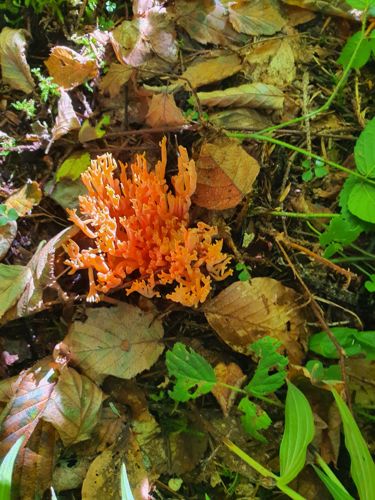
Community find
Orange Coral Fungus
Calocera viscosa
- Group
- coral fungus
- Season
- Most commonly found from late summer through late autumn, often persisting into early winter in milder climates.
- Habitat
- Typically found growing on decaying coniferous wood, such as stumps, logs, and branches. It prefers moist, shaded environments in conifer forests.
- Key characteristics
- Forms dense, antler-like, branched structures that are typically bright orange to yellow-orange. The branches are cylindrical, tough, and somewhat gelatinous, often sticky to the touch. It grows up to 10 cm tall and can be up to 7 cm wide. The tips of the branches are often blunt or rounded. It does not have a distinct cap or stem in the traditional sense.
- Look-alikes
- Some other coral fungi, such as species in the genus Clavulinopsis and Clavaria, can be similar, but Calocera viscosa is distinguished by its vibrant orange color, viscoelastic texture, and preference for coniferous wood. Ramaria species can also be coral-like but are generally larger, fleshier, and often have a more complex branching structure. Dacryopinax spathularia is a small, orange, fan-shaped fungus that grows on wood but does not form complex coral structures.
- Ecological role
- It is a saprobic fungus, meaning it obtains nutrients by decomposing dead organic matter, specifically dead coniferous wood. This plays an important role in the nutrient cycling of forest ecosystems by breaking down woody debris.