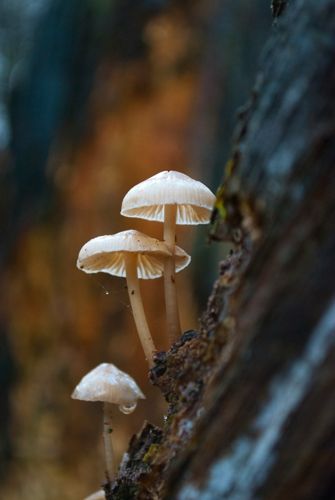
Community find
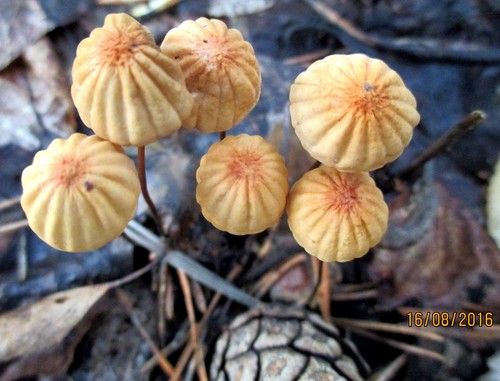
Pinwheel Mushroom (likely a species of Marasmiellus or similar genus)
Marasmiellus genus (species not identifiable from image alone, e.g., Marasmiellus candidus or similar small saprobic white Marasmiellus)
- Group
- Gilled mushroom
- Season
- Typically found from late spring through fall, especially after periods of rain, when moisture levels are high.
- Habitat
- These fungi commonly grow on decaying wood (logs, branches, stumps), leaf litter, or sometimes on moss. They prefer damp, shaded environments found in forests and woodlands.
- Key characteristics
- These mushrooms exhibit small, delicate caps, typically convex to bell-shaped, flattening with age. They are often thin-fleshed and can be whitish, pale brown, or grayish. The gills are generally adnate to adnexed, sometimes nearly free, and widely spaced. The stem is slender, fragile, and matches the cap color or is slightly lighter, often translucent. They are typically small in size, with caps ranging from 1-3 cm in diameter. A spore print would likely be white.
- Look-alikes
- Many small, white-capped gilled mushrooms can appear similar. Lookalikes include other species within the Marasmiellus genus, some small Mycena species (though Mycena often have more conical caps and different gill attachments), and certain species of Hemimycena or Marasmius. Distinguishing features often involve microscopic characteristics, substrate preference, and details of gill attachment or stem texture not discernible from the image.
- Ecological role
- Marasmiellus mushrooms are primarily saprobic, meaning they obtain nutrients by decomposing dead organic matter. They play a crucial role in nutrient cycling in their ecosystems by breaking down woody debris, leaves, and other plant material.