
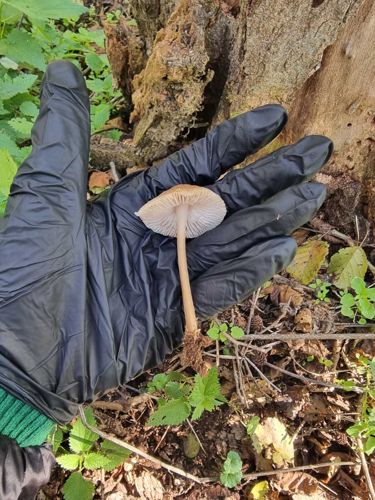
Community find
Pluteus petasatus
Pluteus petasatus
- Group
- gilled mushroom
- Season
- Spring through autumn, sometimes into early winter in milder climates. Requires adequate moisture for fruiting.
- Habitat
- Typically found growing singularly or in small clusters on decaying hardwood, particularly logs, stumps, and wood chips. It is a saprophytic species.
- Key characteristics
- Cap: 5-20 cm broad, convex to broadly convex or nearly flat, with a low broad umbo. White to grayish-brown, often darker towards the center, sometimes with radiating fibers. Gills: Free from the stem, close, white at first, becoming pinkish with age as spores mature. Stem: 5-20 cm long, 0.5-2 cm thick, central, white to cream, often bruising yellowish at the base, typically with fine fibrils, solid. Spore print: Pinkish-brown.
- Look-alikes
- Other Pluteus species, especially those with white caps, but P. petasatus is distinguished by its larger size, robust growth, and typically whiter cap. Careful examination of microscopic features is often necessary for definitive identification within the genus.
- Ecological role
- Pluteus petasatus is a saprobic fungus, meaning it obtains nutrients by decomposing dead organic matter, primarily dead wood. This plays a crucial role in nutrient cycling in forest ecosystems, breaking down complex woody materials into simpler forms that can be reabsorbed by plants and other organisms.