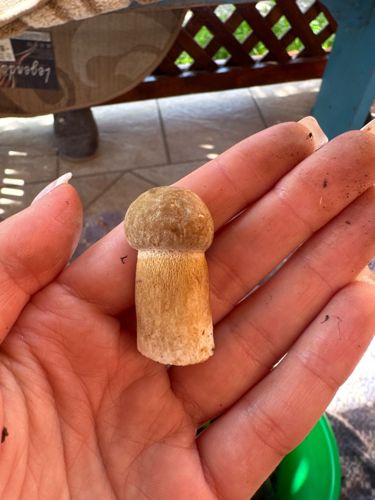
Community find
Porcini Mushroom
Boletus edulis
- Group
- bolete
- Season
- Generally found from late summer to late autumn, depending on the region and specific weather conditions. They often fruit after periods of rain.
- Habitat
- Porcini mushrooms typically grow on the ground in coniferous and deciduous forests. They form mycorrhizal associations with various trees, including pine, spruce, hemlock, fir, oak, and beech.
- Key characteristics
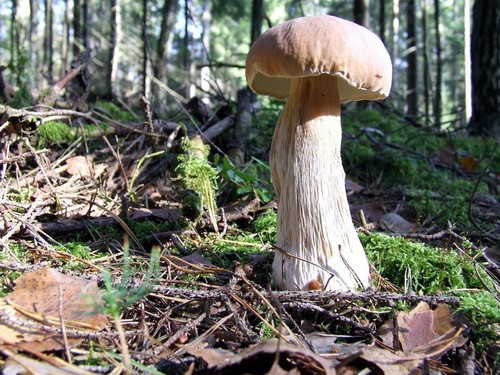
- This small specimen appears to be a young bolete. It has a convex, brownish-tan cap that is smooth. The underside of the cap is not visible, but as a bolete, it would have pores rather than gills. The stem (stipe) is thick, solid, and appears to be a lighter brown or off-white color, slightly club-shaped or cylindrical, and relatively smooth. There is no visible ring (annulus) or volva.
- Look-alikes
- Several other bolete species can resemble Boletus edulis, especially when young. Key distinguishing features for B. edulis include its generally robust build, brown cap, white pore surface (which often yellows or olive-browns with age), and a reticulate (net-like) pattern, especially on the upper part of the stem, though this might not be prominent in very young specimens. Species like Tylopilus felleus (bitter bolete) have pinkish pores and a bitter taste. Different species within the Boletus complex like Boletus pinophilus (pine bolete) or Boletus aereus (bronze bolete) share similar characteristics but might differ in cap color, habitat, or subtle stem features. Accurate identification requires examining mature specimens and specific features like pore color, bruising reactions, and spore print.
- Ecological role
- Porcini mushrooms are mycorrhizal, forming symbiotic relationships with the roots of certain trees. They exchange nutrients with the trees, helping them absorb water and minerals from the soil, while the trees provide the fungi with sugars produced through photosynthesis. They play a vital role in forest ecosystems by facilitating nutrient cycling.