Mower's Mushroom
Panaeolus foenisecii
Also called lawn mower's mushroom, brown hay cap, haymaker
A very common small brown lawn mushroom whose hygrophanous cap dries in distinct pale bands, with mottled brown gills and dark purplish-brown spores.
Overview
Mower's Mushroom is arguably the most frequently seen mushroom in mown grass across the temperate world. It appears in scattered numbers on lawns from late spring onward, usually within a day or two of rain, and its dull brown cap is easy to overlook.
The species has been shuffled between Panaeolus and Panaeolina, the latter genus separated on the basis of its roughened, ornamented spores and slightly paler, browner spore deposit. In the field it sits comfortably with the mottlegills, sharing their mottled gill faces caused by uneven spore ripening across the gill surface.
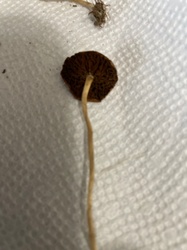
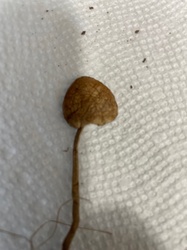
Its most helpful character is the way it dries. A moist cap is dark reddish or date-brown; as it loses water the colour retreats in concentric zones, leaving a paler tan outer band or a two-tone bullseye that is quite distinctive once learned.
How to identify it
Cap
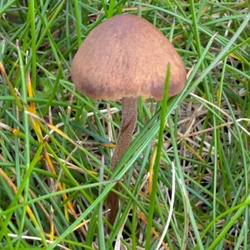
Small, 1-3 cm across, hemispherical to broadly convex or bluntly bell-shaped, never fully flat. Smooth and dry to the touch and strongly hygrophanous: dark date-brown or reddish-brown when moist, drying to dull tan or greyish buff, typically from the centre outward so that a darker marginal band remains for a time.
Gills
Adnate, moderately crowded, broad, pale grey-brown at first, then mottled with darker and lighter patches as the spores mature unevenly, finally dark brown. The gill edges usually remain narrowly whitish.
Stipe
Slender and straight, 4-8 cm tall and 1-3 mm thick, hollow and fairly brittle, pale grey-brown to buff, sometimes minutely pruinose near the apex. There is no ring and no veil fringe on the cap margin.
Flesh & spore print
The flesh is thin and brownish. The spore print is dark purplish brown to chocolate brown, not the jet black of some relatives. Under a microscope the spores are distinctly warted or roughened.
Where and when it grows
It grows directly in grass: mown lawns, sports fields, verges, pasture, parkland, and any regularly cut turf, frequently in the same spots year after year. It favours short, fertile, well-watered grass and often appears in numbers a day or two after mowing and rain, which is the origin of both its common names.
The season extends from late spring through autumn wherever temperatures are mild and the ground is damp. The species is cosmopolitan and abundant across Europe, North America, Australia, and beyond, spreading readily with cultivated lawns.
Ecological role
Panaeolus foenisecii is a saprotroph of grassland thatch and soil organic matter. Its mycelium breaks down grass clippings, dead roots, and humus in the upper few centimetres of turf rather than depending on dung or living plants, though it clearly benefits from the nutrient enrichment of fertilised lawns.
Fruiting is fast and opportunistic: caps expand overnight, shed spores over a day or two, and then shrivel. Because the mycelium is perennial within a lawn, flushes recur through the season whenever rain and warmth coincide, and mowing itself supplies fresh clippings that feed the colony.
Similar species
Panaeolus papilionaceus shares the lawn and grassland habitat but has a jet-black spore print and, when young, conspicuous whitish veil teeth hanging from the cap margin. Panaeolus cinctulus is broader-capped with a persistent dark marginal band and a blackish spore deposit.
Psathyrella species in grass have far more brittle white stems and a purple-black spore print, while Conocybe species have conical caps and a rusty ochre spore print. Agrocybe lawn species are larger, with tan caps, a ringed stem in some species, and dull brown spores.
Common questions about Mower's Mushroom
Why does it appear after mowing?
What is the banded cap effect?
What does mottled gills mean?
What is the spore print colour?
Mower's Mushroom found by the community
Photos submitted through the app and matched to this entry.