
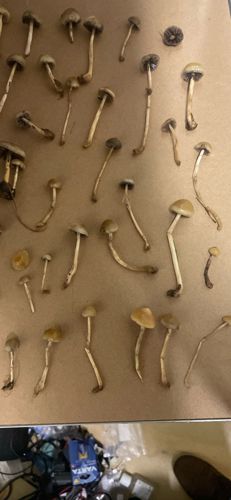
Community find
Psilocybe semilanceata
Psilocybe semilanceata
- Group
- Gilled mushroom
- Season
- Typically found in late summer, autumn, and early winter, often after periods of rain, when temperatures are cool but above freezing. Its fruiting season can extend into winter in milder climates.
- Habitat
- Found in grasslands, meadows, pastures, and lawns, particularly in rich, acidic soils that have been fertilized with animal dung (especially sheep or cattle). It does not grow directly on dung but in the surrounding grass. Often found in disturbed areas.
- Key characteristics
- Cap is typically 0.5-2.5 cm in diameter, conic to bell-shaped, often with a prominent central papilla or nipple. It is hygrophanous, meaning its color changes with moisture, from a dark yellowish-brown to olive-brown when wet, fading to a lighter tan or buff when dry. The margin of the cap is often striate (grooved) when moist. Gills are adnate to adnexed, close, and range from cream to pale brown when young, becoming dark purplish-brown with age. The stem is slender, typically 3-10 cm long and 0.1-0.3 cm thick, pale cream to yellowish-brown, often twisted or wavy, and tough. A bruising reaction, where the stem turns bluish-green, is often present, especially near the base. Spore print is dark purplish-brown.
- Look-alikes
- Several species can be mistaken for Psilocybe semilanceata. Some common look-alikes include various species of Psathyrella, Panaeolus, Mycena, and Stropharia. Key distinguishing features for Psilocybe semilanceata include its distinct conical shape with a prominent papilla, the tough and often twisted stem, and the dark purplish-brown spore print. Some poisonous Galerina species, such as Galerina marginata, can also be confused with it, but Galerina typically grow on wood and have a rusty-brown spore print, a ring on the stem, and a non-hygrophanous cap.
- Ecological role
- Psilocybe semilanceata is a saprophytic fungus, meaning it obtains nutrients by decomposing organic matter. It plays a role in nutrient cycling in grassland ecosystems, breaking down dead plant material in the soil.