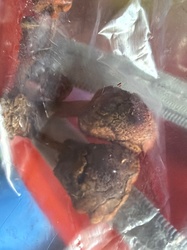
Liberty Cap
Psilocybe semilanceata
Also called witch's hat, pixie cap
A small, slender grassland mushroom with a sharply conical cap ending in a distinct nipple, a separable gelatinous cap skin, a wavy thin stem and a dark purple-brown spore print.
Overview
Psilocybe semilanceata is a member of the Hymenogastraceae and one of the most morphologically distinctive small grassland agarics in temperate regions. Its name means half-lance-shaped, describing the narrow, sharply conical cap, and the English name derives from the resemblance of that cap to the pointed Phrygian cap used as a liberty emblem.
Everything about the fungus is small and slender. Caps rarely exceed 2.5 cm across, stems are thread-thin and often noticeably wavy or sinuous, and the whole fruit body stands only a few centimetres above the turf, so it is easily overlooked among grass stems. The single most useful structural feature is the small, sharply pointed papilla, a nipple or teat, at the very apex of the cap, present at every stage of development.
The genus Psilocybe as currently circumscribed contains small dark-spored saprotrophs of grassland, dung-enriched soil and woody debris, characterised by dark purple-brown to purple-black spore prints, hygrophanous caps, and tissues that discolour bluish where damaged. P. semilanceata is the classic grassland representative and is among the most frequently recorded fungi of upland pasture in western Europe.
How to identify it
Cap
0.5-2.5 cm across and often taller than wide, sharply conical to bell-shaped, and never expanding fully flat. It is topped by a small but distinct pointed papilla. The surface is smooth and, in damp weather, viscid, with a gelatinous outer pellicle that can be peeled away in one piece with a fingernail, a very reliable field test. Colour is hygrophanous: olive-brown, ochre-brown or chestnut when moist, drying to pale buff or straw from the top down, sometimes with a faint bluish or greenish tinge near the base of the cap. The margin is often finely striate when wet and may be slightly incurved and darker.
Gills
Adnexed to narrowly attached and easily seceding, moderately crowded and narrow. They are pale cream to greyish at first, then clay-brown, and finally dark purple-brown to almost purple-black as the spores ripen, usually keeping a paler, finely fringed white edge that shows under a lens.
Stipe
4-10 cm tall but only 1-2 mm thick, very slender, flexible and typically wavy or sinuous rather than straight. It is pale buff to yellowish brown, smooth or minutely fibrillose, and there is no ring, though very young fruit bodies may show a faint cortina-like veil that leaves no lasting trace. The base often carries white mycelial threads binding grass roots, and it commonly develops a blue-green discoloration where handled, bruised or ageing.
Flesh and spore print
The flesh is thin, pale and membranous. The spore print is dark purple-brown, one of the darkest among small grassland mushrooms. Spores are smooth, ellipsoid and thick-walled with a distinct germ pore.
Where and when it grows
The Liberty Cap is a fungus of grassland, particularly old, unimproved, nutrient-enriched pasture, upland sheep and cattle grazing, hill fields, damp meadows, lawns, playing fields, roadside verges and grassy dunes. It favours acidic to neutral soils with a good depth of grass thatch and is most abundant where livestock have grazed for many years, although it grows among the grass roots rather than directly on dung.
Fruiting is strongly seasonal, beginning in early autumn and peaking after the first cold nights, typically from September through November in northern Europe, and it can continue until hard frost. Fruit bodies appear scattered or in large troops, sometimes in the hundreds across a single field, standing individually among the grass rather than in clusters. The species is widespread across northern and western Europe, is common in Britain and Ireland, and also occurs in parts of North America, temperate South America, and other cool temperate regions.
Ecological role
Psilocybe semilanceata is a saprotroph. It lives on dead and decaying grass roots, leaf sheaths and thatch in the upper few centimetres of turf, and it does not form any partnership with living plant roots. The white mycelial cords visible at the stem base are the feeding network binding fragments of decomposing grass, and their activity helps recycle the dense root mat of old pasture back into soil organic matter.
The association with grazed land reflects the nitrogen enrichment and the thick, continually renewed root thatch that grazing produces, rather than a direct link to dung. Fruiting is triggered by falling night temperatures combined with autumn moisture, which is why the species appears so reliably after the first cold snap. The blue-green colour change in damaged tissue is an oxidation reaction of pigments in the fruit body and is a normal structural feature used in identification.
Similar species
Panaeolina foenisecii, the Mower's Mushroom, grows in the same lawns and pastures but has a rounded, non-papillate, evenly convex cap, mottled or spotted gill faces, no separable gelatinous pellicle and a dull dark brown rather than purple-brown spore print. Panaeolus species share dark spores and mottled gills but again lack the sharp cap papilla and the peelable cap skin.
Protostrophaia semiglobata and Stropharia semiglobata are much larger and hemispherical with a sticky yellow cap and a ring zone on a longer sticky stem. Conocybe and Pholiotina species of grassland are similar in size and stature but have conical caps without a papilla, rusty to cinnamon-brown gills and a rusty brown spore print. Small Mycena species in grass are separated by white spore prints and brittle, non-peelable cap surfaces.
Within Psilocybe, Psilocybe fimetaria and related taxa can look similar but grow directly on dung, are stockier, and often show a distinct veil remnant on the stem. The combination of a sharply papillate conical cap, a cap skin that peels as a rubbery film, a thread-thin wavy stem and a dark purple-brown print is unique to the Liberty Cap among grassland fungi.
Common questions about Liberty Cap
What is the most distinctive feature of the Liberty Cap?
What is the peeling test?
Does it grow on dung?
When and where does it appear?
Guides
Liberty Cap found by the community
Photos submitted through the app and matched to this entry.