
Community find
Red Raspberry Slime Mold
Tubifera ferruginosa
- Group
- Slime Mold
- Season
- Commonly found from late spring through fall, especially after periods of rain, as moisture is essential for their development and fruiting.
- Habitat
- Found on decaying wood, logs, stumps, and leaf litter in humid, shaded environments, particularly in forests. It prefers moist conditions.
- Key characteristics
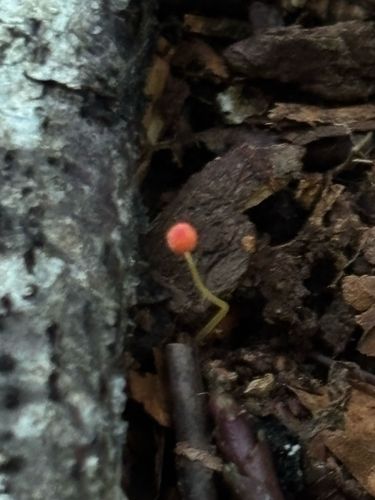
- The Red Raspberry Slime Mold (Tubifera ferruginosa) forms pseudoaethalia, which are cushion-shaped to hemispherical, typically 1-5 cm across. They are composed of numerous cylindrical sporangia tightly packed together, resembling a raspberry. Initially, they are bright red, orange, or pink, often shiny, eventually turning dull reddish-brown to dark brown as they mature. The individual sporangia are typically 2-5 mm tall. It lacks a true cap and stem structure typical of gilled mushrooms. The 'stem' seen in the image is likely a stipe-like base or part of the pseudocolumella, common for Tubifera. Spore print is rusty brown.
- Look-alikes
- Other Tubifera species, though Tubifera ferruginosa is distinctive due to its bright red to orange color when young and raspberry-like appearance. Other slime molds might have different colors or growth forms, such as those that are more net-like or entirely different shapes. Some immature polypores could be mistaken from a distance, but close inspection reveals the distinct sporangia structure of the slime mold.
- Ecological role
- Slime molds like Tubifera ferruginosa are saprophytic organisms. They play a crucial role in decomposition by consuming bacteria, yeasts, and other microorganisms found in decaying organic matter, contributing to nutrient cycling in forest ecosystems. They are not fungi but protists.