Community find
Shaggy Parasol
Chlorophyllum rhacodes
- Group
- Gilled mushroom
- Season
- Late summer to autumn.
- Habitat
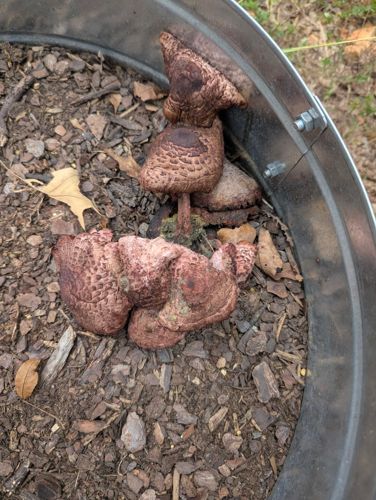
- Typically found growing singularly or in groups on disturbed ground, in gardens, woods, parks, and along roadsides. It is often associated with woodland edges or areas with decaying wood or wood chips.
- Key characteristics
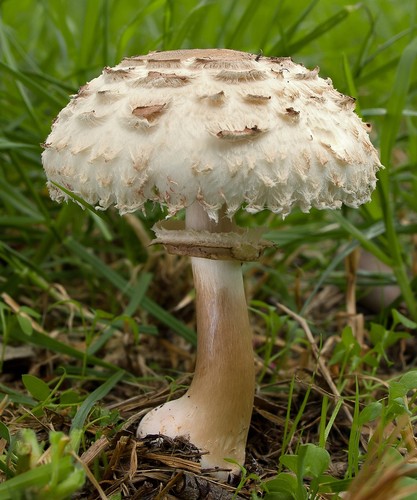
- Cap: 5-15 cm in diameter, initially egg-shaped, expanding to convex or nearly flat with a distinct dark brown or reddish-brown center. The cap surface is covered with large, shaggy, brownish scales over a lighter background. Gills: Free, crowded, white to cream, bruising reddish when damaged. Stem: 8-20 cm long, 1-2 cm thick, typically tapering slightly upwards, with a large, movable, double ring. It is usually whitish to brownish, and may bruise reddish-brown. Spore print: White to cream.
- Look-alikes
- Chlorophyllum molybdites (the 'green-spored parasol') is highly toxic and has a green spore print and often lacks the reddish bruising. Macrolepiota procera (the 'parasol mushroom') has a snakeskin pattern on the stem, a less shaggy cap, and does not bruise reddish. Leucoagaricus americanus also has a shaggy cap and can bruise reddish, but typically grows in disturbed areas with wood debris and has a more bulbous base.
- Ecological role
- Saprotrophic, playing a crucial role in breaking down organic matter, especially decaying wood and leaf litter, and recycling nutrients back into the ecosystem.