Community find
Shaggy Scalycap
Pholiota squarrosa
- Group
- gilled mushroom
- Season
- It is most commonly found from late summer through fall, often persisting until the first hard frosts. Fruiting is dependent on adequate moisture and appropriate temperatures.
- Habitat
- This mushroom is typically found growing in clusters or solitary on dead or decaying hardwood and sometimes softwood stumps, logs, and living trees, often near the base of the trunk. It can also appear on buried wood.
- Key characteristics
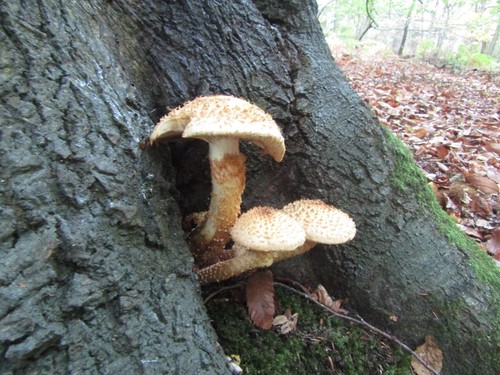
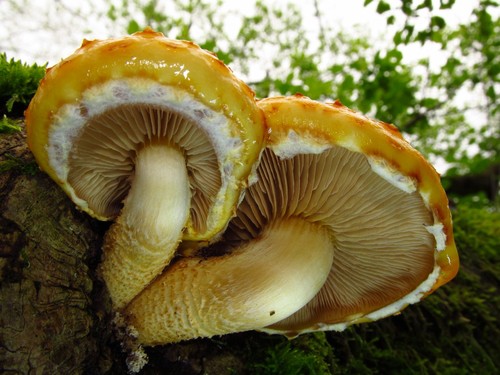
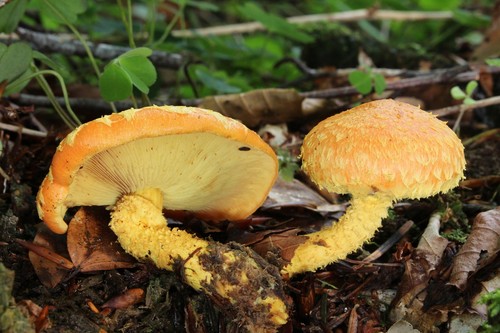
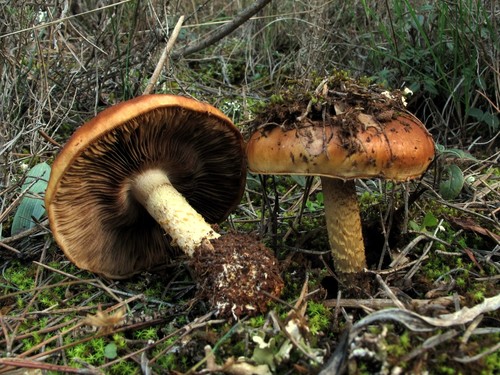
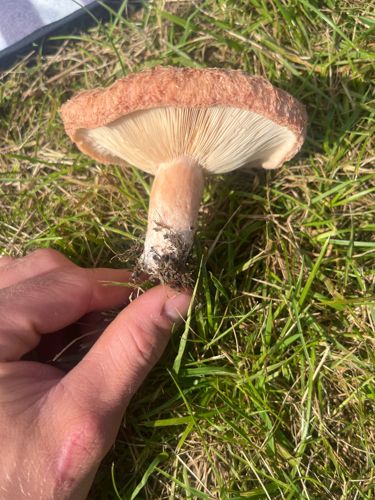
- The mushroom in the image appears to be a Shaggy Scalycap (Pholiota squarrosa). Its cap is typically convex to broadly convex, becoming flatter with age, and covered in prominent, pointed, reddish-brown to tan scales, giving it a shaggy appearance. The gills are adnate to adnexed, close, and range from whitish to pale yellow when young, becoming rusty brown as spores mature. The stem is roughly the same color as the cap, often with a ring, and features numerous downward-pointing scales below the ring. The spore print is rusty brown.
- Look-alikes
- Similar species include Pholiota subsquarrosa, which has less robust scales and a more yellow-brown cap, and some species of Armillaria (honey mushrooms), which typically have a stronger annulus and do not have the same prominent, upright shaggy scales on the cap. Distinguishing features are the distinct shaggy scales on both the cap and stem.
- Ecological role
- It is a saprophytic fungus, meaning it obtains nutrients by decomposing dead organic matter. It plays a significant role in nutrient cycling by breaking down dead wood, contributing to the health of forest ecosystems.