Community find
Shingled Hedgehog
Hydnum repandum
- Group
- gilled mushroom
- Season
- Commonly found from late summer through late autumn, especially after periods of rain.
- Habitat
- This species is mycorrhizal, forming symbiotic relationships with a variety of trees, including conifers and hardwoods (especially beech and oak). It typically grows on the ground, often scattered or in groups, in mossy, deciduous, or coniferous forests.
- Key characteristics
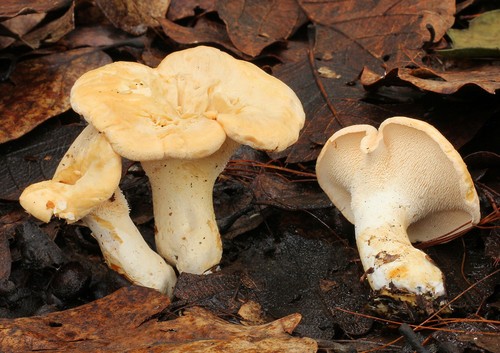
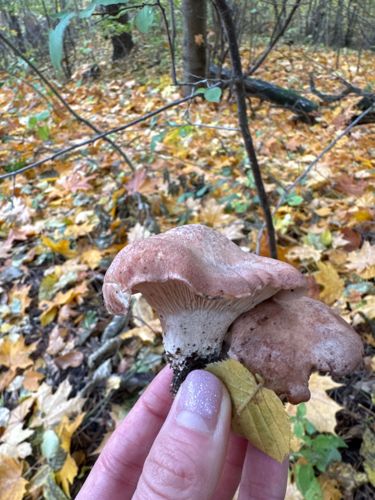
- The cap of Hydnum repandum is typically convex to flat, often with an irregular or wavy margin, and can range from cream to orange-tan or pinkish-brown in color. Its surface is often dry and can be finely velvety or scaly, resembling roof shingles in some specimens. Instead of gills, it has soft, brittle, tooth-like spines (hydnoids) on the underside of the cap, which are whitish to pale cream and easily detached. The stem is solid, central or eccentric, stout, and can be white to buff, often darkening with age. Spore print is white to creamy.
- Look-alikes
- Similar species include the Terracotta Hedgehog (Hydnum rufescens), which is generally smaller, more uniformly colored (orangish-brown to terracotta), and has a more central stem. Another similar species is the Giant Hedgehog (Hydnum albidum), which has a paler, often whitish cap and grows larger. The presence of spines instead of gills is a key distinguishing feature from most other gilled mushrooms.
- Ecological role
- As a mycorrhizal fungus, Hydnum repandum forms a mutually beneficial relationship with tree roots. It helps trees absorb water and nutrients from the soil, while the trees provide the fungus with carbohydrates produced through photosynthesis. It plays an important role in nutrient cycling within forest ecosystems.