
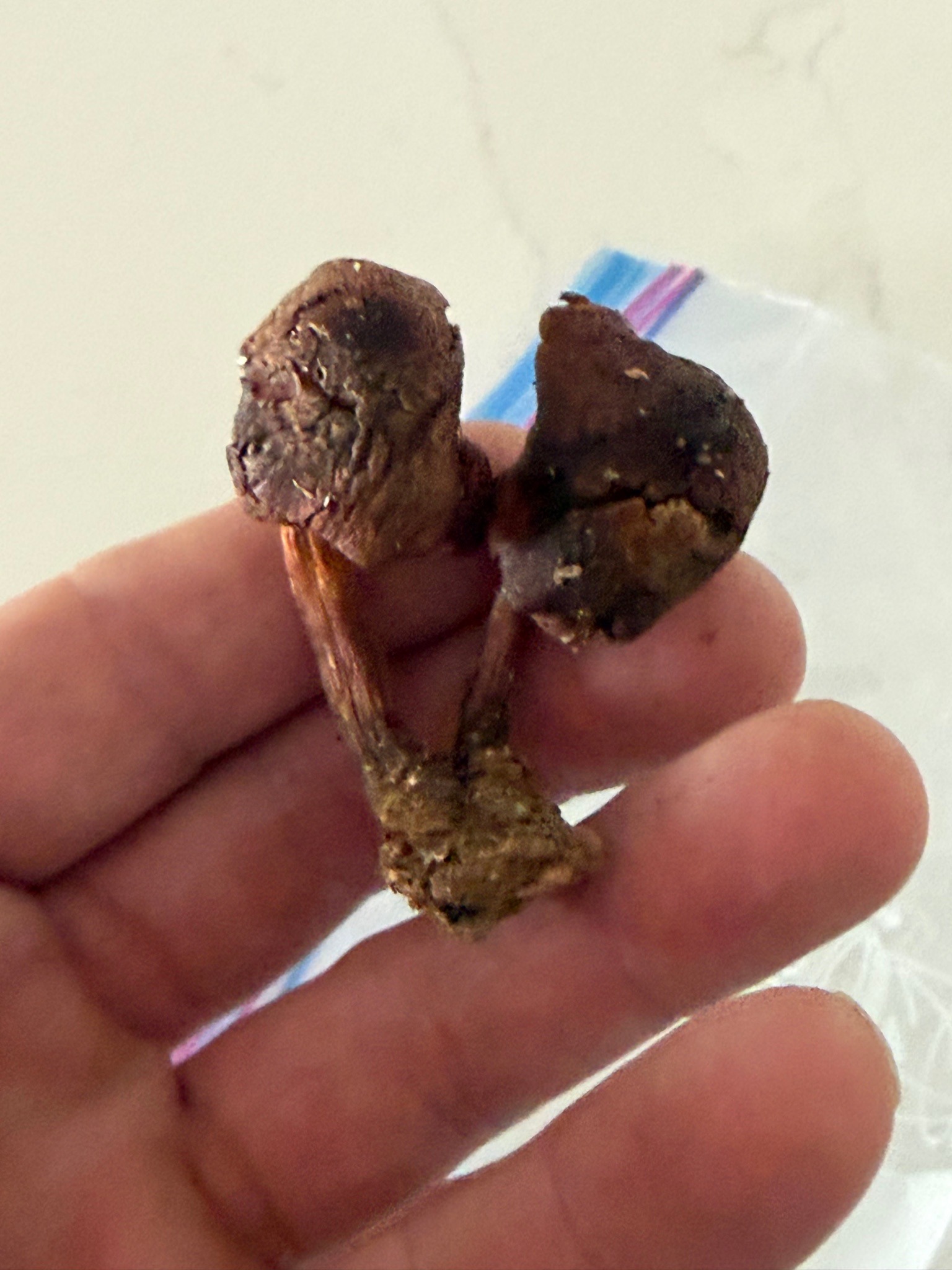
Community find
Subaeruginosa Mushroom
Psilocybe subaeruginosa
- Group
- gilled mushroom
- Spore print
- Dark purple-brown to blackish.
- Size
- Cap diameter: 1-6 cm; Stipe: 4.5-12 cm long and 0.2-0.5 cm thick.
- Season
- Primarily fruits during the cooler months, typically from late autumn to winter, following significant rainfall and drop in temperature.
- Habitat
- This species Typically grows in woody debris, mulch, gardens, and along tracks in forest environments. It is often found associated with wood chips in urban landscaping or in pine plantations.
- Distribution
- Commonly found in southeastern Australia, including New South Wales, Victoria, and Tasmania, as well as parts of New Zealand.
- Key characteristics
- The mushroom is shown in a dried state, which alters its typical appearance. In its fresh state, it features a conic to convex cap that often develops an umbo (a central bump). The color ranges from caramel to ochre-brown, often fading when dry. The gills are adnate to sinuate and start pallid before turning dark brown. The stem (stipe) is white to brownish and often exhibits blue bruising when handled or damaged. Dried specimens like these appear shriveled, dark brown, and brittle.
- Fruiting body
- The cap is typically 1-6 cm in diameter, smooth and viscid when moist. The gills are crowded and initially covered by a thin partial veil. The stipe is 4-12 cm long and very fibrous. When dried, as in the image, the cap shrivels, the dark spores may coat the gills and stem, and the flesh becomes tough and leathery.
- How to recognise it
- Key field diagnostic features include the caramel-colored cap, dark purple-brown spores, and the distinct blue-green bruising reaction of the flesh and stem when injured.
- Look-alikes
- Psilocybe cyanescens, Psilocybe azurescens (both are closely related and look similar), and certain poisonous Galerina species which can be distinguished by their rusty orange spore prints.
- Ecological role
- Saprophytic, meaning it derives its nutrients by breaking down dead organic matter, particularly wood and leaf litter.
- Notes
- This species was first described scientifically in 1927 by Australian mycologist John Burton Cleland. It is often of interest to mycologists due to its unique chemical profile and its ability to thrive in anthropogenically disturbed habitats like botanical gardens and mulched parks.