Community find
Violet-toothed Polypore
Trichaptum biforme
- Group
- polypore/crust fungus
- Spore print
- White
- Size
- Cap diameter: 1-7 cm; Thickness: 1-3 mm; no stipe (sessile).
- Season
- Year-round; active fruiting in summer and fall, but persistent through winter.
- Habitat
- Grows primarily on dead hardwoods, especially oak and beech; can also be found on birch and cherry.
- Distribution
- Widely distributed across North America, Europe, and Asia.
- Key characteristics
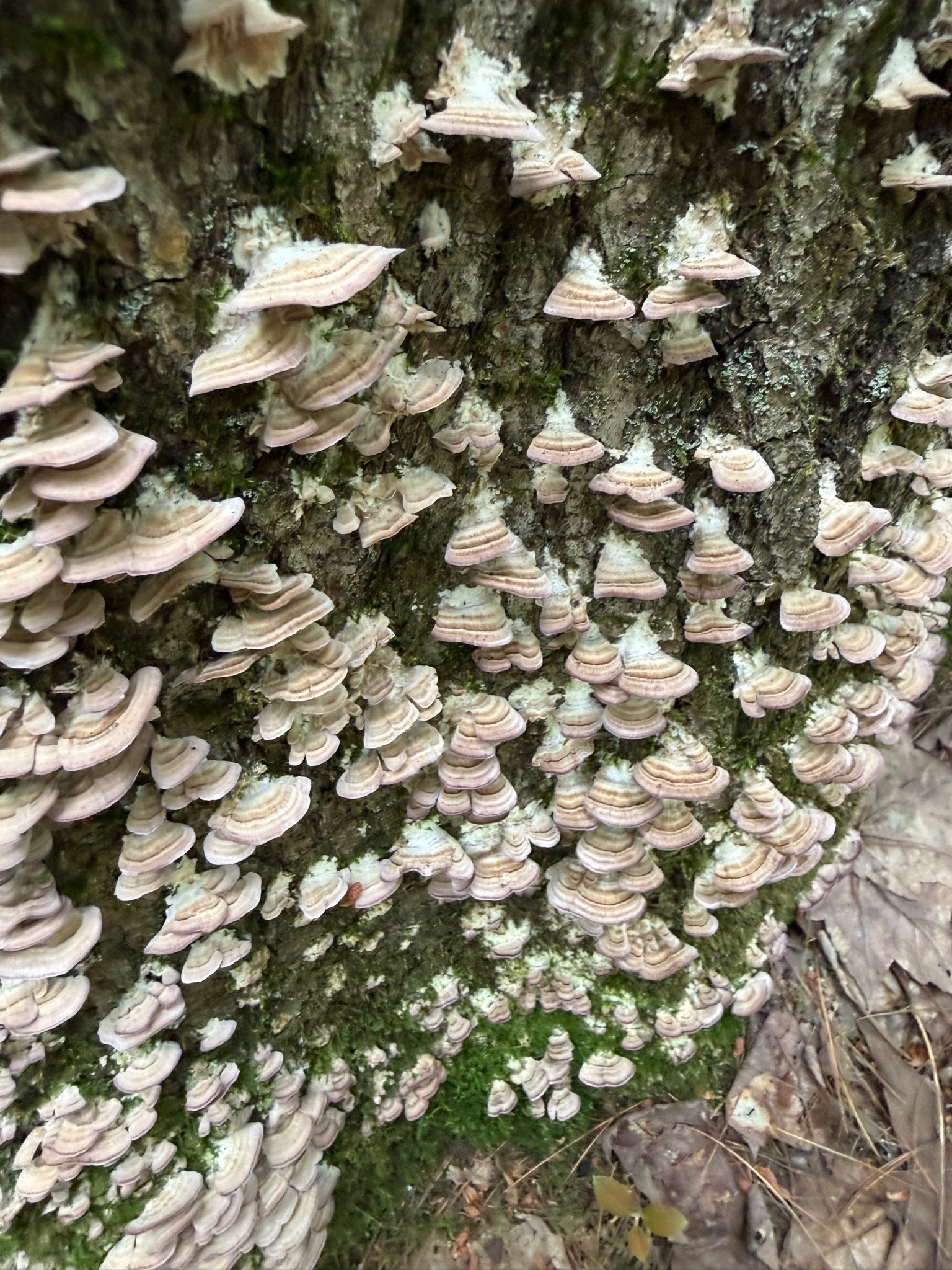
- Zoned cap colors of white, gray, and tan with a distinct violet or purple edge on fresh specimens; small, thin, fan-shaped brackets; underside has tooth-like pores.
- Fruiting body
- Cap is 1-7 cm wide, thin, flexible when fresh but brittle when dry; surface is finely hairy (velvety) and zoned; the fertile undersurface (hymenophore) starts with violet pores that break into jagged teeth as it matures.
- How to recognise it
- Look for the lilac or violet tint on the outer margin and the tooth-like projections on the underside. It is often found in massive, overlapping 'shelves' covering large sections of logs.
- Look-alikes
- Trametes versicolor (Turkey Tail) which has a smooth pore surface rather than teeth; Trichaptum abietinum which grows on conifers.
- Ecological role
- Saprophytic; causes white rot by breaking down both lignin and cellulose in dead hardwood trees.
- Notes
- The violet color often fades to brown or white as the specimen ages. In older specimens, the cap surface may appear green due to the growth of symbiotic algae within the hairy surface fibers.