Violet-toothed Polypore
Trichaptum biforme
Also called violet toothed polypore, purple-toothed bracket
Thin, flexible brackets massed in rows along dead hardwood, recognised by an underside that is violet when fresh and breaks up into ragged teeth with age.
Overview
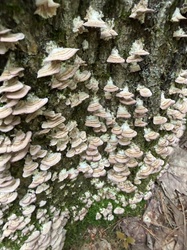
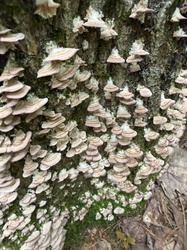
The Violet-toothed Polypore is among the most abundant bracket fungi on fallen hardwood in temperate forests, often clothing an entire log in dense overlapping ranks of small thin fans. Its identity rests on the underside: fresh fruit bodies show a distinctly violet to purple pore surface, and as the bracket matures those pores break down into an irregular, tooth-like or partly maze-like surface that no true polypore of similar shape produces.
Trichaptum is a small genus defined by exactly this combination of a violet hymenophore that degenerates into teeth. It sits within the Hymenochaetales and is only distantly related to Trametes, despite the similar overall silhouette. The violet pigment is fugitive: it can drain from older brackets to leave a plain buff or pale brown surface, which is why finding a young specimen along the same log is worth the effort.
Because it fruits year-round wherever suitable wood is available, it is one of the fungi most reliably encountered on a winter walk.
How to identify it
Cap
Brackets are 1-6 cm across and only 1-3 mm thick, semicircular, fan-shaped or shell-like, broadly attached and stalkless, and characteristically fused laterally into long dense rows and overlapping tiers. The upper surface is finely hairy to velvety, whitish, pale grey or greyish tan, with faint concentric zoning, and is very commonly greened by algae. The thin margin is often tinged violet in fresh specimens — a useful clue when the underside has already faded.
Pores and teeth
The underside is violet, lilac or purplish when young and fresh, fading through pinkish buff to plain tan or pale brown with age and weathering. Pores start as angular openings at roughly 2-4 per millimetre, but as the bracket expands their walls split and erode so that the surface becomes irregularly toothed, jagged or partly labyrinthine. A mature bracket may show pores near the margin and ragged teeth toward the base at the same time.
Flesh & spore print
The context is white to pale buff, very thin, tough and flexible when damp, becoming stiff and brittle when dry, and it rehydrates readily. In section a thin violet layer may be visible just above the tubes. The spore print is white.
Where and when it grows
It fruits on dead hardwood — fallen trunks, standing dead stems, stumps and large branches — with birch the classic host, followed by oak, beech, maple, cherry, aspen and many others. It appears preferentially on wood that has lost its bark, spreading in long continuous bands over the exposed surface, and it is common on both sunlit and shaded logs.
The species is widespread and abundant across North America, Europe and Asia in temperate and boreal forest. New growth is heaviest from summer into late autumn, but the thin brackets persist and rehydrate through winter, so it can be found in fruiting condition in any month.
Ecological role
This is a saprotroph causing a white rot, breaking down lignin along with cellulose and reducing hardwood to a pale, soft, fibrous state. It is an early coloniser, typically arriving within a season of the wood dying, and it can carpet a newly fallen trunk more thoroughly than almost any other bracket.
Its sheer abundance makes it a significant component of the deadwood community. The dense ranks of brackets create sheltered damp micro-sites used by springtails, mites and beetle larvae, and the fruit bodies themselves are host to fungicolous species including Phaeocalicium and small ascomycete parasites. Later-stage decomposers generally displace it as the log softens.
Similar species
Trichaptum abietinum is the near-twin but grows on conifer wood, is smaller, often more crust-like with only a narrow reflexed bracket edge, and typically shows a more finely poroid to shallowly toothed surface. Trichaptum fuscoviolaceum, also on conifers, has a hymenophore developed into pronounced radial spines and plates.
Trametes versicolor is superficially similar from above but has a persistent white round-pored underside that never turns violet or breaks into teeth, and is usually more strongly and colourfully zoned. Stereum species have a completely smooth underside with no pores or teeth at all. Schizophyllum commune has split, folded gill-like plates and a densely white-woolly upper surface.
Common questions about Violet-toothed Polypore
What if the underside is not violet?
Pores or teeth — which is it?
How do I separate it from the conifer species?
Can I find it in winter?
Violet-toothed Polypore found by the community
Photos submitted through the app and matched to this entry.