Identification guide
Amber Jelly Roll Identification Guide
How to identify Exidia recisa, the translucent amber jelly that erupts from dead willow twigs after winter rain, from its narrow point of attachment and smooth fertile surface to its allantoid spores and jelly-fungus look-alikes.
The First Impression
The Amber Jelly Roll (Exidia recisa) is a wet-season fungus, and you meet it in conditions when most people are not looking for fungi at all: a mild, sodden day in winter or early spring, with bare branches dripping. Walking a willow-lined ditch, a riverside path or a damp scrub margin, you notice what looks like a row of amber beads strung along a dead but still-attached twig. Held up against the light they glow orange-brown and are obviously translucent.
Everything about the first impression is worth recording. Note the host twig, note that it is dead but has not yet fallen, note how the individual jellies are spaced along it, and note the recent rainfall. This species is effectively invisible in dry spells, so its apparent absence from a site means very little.
Reading the Fruit Body
Shape and attachment. Each fruit body is 1-4 cm across, top-shaped or turbinate, and often flattened laterally so that it looks like a small tongue, wedge or shallow ear. Critically, it narrows downward to a slender point or short stalk-like base by which it is fixed to the bark. Take hold of one and rock it: it is attached at a small area, not spread broadly across the wood. That narrow attachment is one of the best characters in the genus and is worth confirming on several specimens.
Colour and translucency. Fresh material ranges from pale honey and amber through tawny to a warm reddish-brown, darkening with age and with exposure. It is translucent enough that you can see the outline of a fingertip through a thin edge.
Surface. The exposed face, which carries the hymenium, is smooth to gently undulating or shallowly folded, slightly shining when wet. There should be no pimples, no scattered dark warts and no coarse brain-like convolutions. The lower and attached parts are duller and finely wrinkled.
Consistency. Firmly gelatinous and elastic. Press it and it dents and springs back; pull it and it stretches before parting. It is not soft and slimy, and not tough and rubbery.
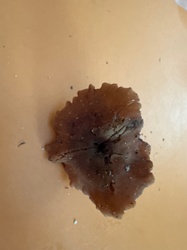
Drying behaviour. This is the single most characteristic ecological trait. In dry conditions the jelly shrinks to a thin, hard, dark reddish-brown to almost black flake or crust pressed flat against the bark, easily mistaken for a scar or an old insect gall. After a few hours of rain the same flake swells back into a plump amber blob. Marking a twig and revisiting it across a wet and a dry spell is a satisfying way to confirm the identification.
Spore Deposit and Microscopy
Jelly fungi do produce prints, but they need care. Choose a fully hydrated fruit body, cut the twig either side of it, and suspend the piece with the fertile face downward a couple of millimetres above a clean glass slide or a piece of black card, inside a closed container with a little damp tissue to keep humidity high. Leave it overnight. The deposit is white and typically thin, so examine the slide at a low angle against a dark background.
Under the microscope the spores are the confirmation: hyaline, smooth, and allantoid, that is, distinctly curved like a sausage, roughly 12-16 by 4-5 micrometres. The basidia are the other key structure, being longitudinally divided into four cells by vertical septa, with long slender projections carrying the spores. Transversely septate basidia would place a specimen in Auricularia, and tuning-fork shaped basidia would place it in Dacrymyces, so a single squash mount separates the three main groups of jelly fungi.
Substrate, Season and Ecology
Exidia recisa is a saprotroph of recently dead attached wood. Its principal host is willow, and it appears again and again on dead twigs and small branches still held in the crown or in the tangle of a coppiced stool. Other broadleaved hosts, including poplar, hazel, ash and oak, are recorded, but a willow-dominated wet habitat is the classic search image.
Fruiting is concentrated in the cool, wet half of the year, from autumn through winter into spring, and it is triggered by rainfall rather than by a narrow calendar window. The fungus survives dry intervals in the desiccated state described above, so a single colonised branch can produce the same visible crop repeatedly over more than one season. Search dead standing willow scrub, ditch and pond margins, damp woodland edges and river banks, and look at branch level rather than at your feet.
Separating the Look-alikes
Exidia glandulosa, the black witches' butter, is black or blackish-brown, broadly attached, and its surface is studded with small conical warts or pimples. It typically fuses into long lumpy masses along oak branches rather than sitting as separate amber tops.
Exidia repanda is brownish and disc-shaped but flatter and more broadly attached, and it favours birch.
Exidia thuretiana is whitish and translucent, forming broadly attached, brain-like or lobed cushions on broadleaved wood.
Myxarium nucleatum, sometimes treated in Exidia, is a colourless to whitish jelly containing tiny opaque white mineral granules visible against the light, a character no amber Exidia shows.
Tremella mesenterica is bright yellow to orange, strongly folded and brain-like, broadly attached, and it grows in association with crust fungi on dead attached branches. Tremella foliacea is a brown rosette of thin wavy leaf-like lobes, again broadly attached, and is much larger and more ruffled.
Auricularia auricula-judae is far bigger, ear-shaped and cupped, with a distinctly veined and folded inner face and a minutely velvety, matt outer face, and it has a tougher, more rubbery texture. It is strongly associated with elder.
Dacrymyces species are small orange to yellow cushions or blobs, usually more opaque and more saturated in colour, and they occur very commonly on conifer wood and worked timber.
A Working Sequence
Confirm the host and that the wood is dead but still attached. Check that the jelly is amber and translucent, smooth-surfaced, narrowly attached, and elastic rather than slimy. Look for shrivelled black flakes on the same twig as evidence of earlier crops. Then confirm with allantoid spores and longitudinally septate basidia if microscopy is available.
Common questions
What makes Exidia recisa recognisable in the field?
Which wood and season should I be searching?
Why does it seem to vanish and reappear on the same twig?
How do I separate it from Exidia glandulosa and Auricularia auricula-judae?
Full reference entry for Amber Jelly Roll
Cap and fruiting body, spore print colour, substrate, season, ecological role and the species most often confused with it.
Open the Amber Jelly Roll entry →