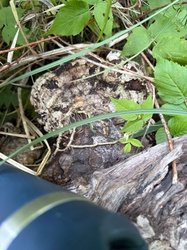
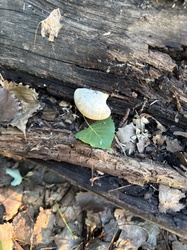
Birch Polypore
Fomitopsis betulina
Also called razor strop fungus, birch bracket, birch conk
A smooth, pale, rubbery bracket that grows almost exclusively on birch, recognised by its rounded kidney shape, thick inrolled margin and fine white pore surface.
Overview
The Birch Polypore is one of the most host-faithful bracket fungi in the northern hemisphere: wherever birch grows, its pale hemispherical brackets sooner or later appear on dying and fallen trunks. Formerly placed in the genus Piptoporus, it is now treated as Fomitopsis betulina, a member of the Fomitopsidaceae — a family of brown-rot bracket fungi that also includes the red-belted conks and the sulphur shelf group.
What sets it apart from most brackets is its texture. Rather than the woody hardness of a perennial conk, a fresh Birch Polypore is corky-rubbery and surprisingly light, with a thin, separable skin over dense white flesh. Each bracket is an annual structure: it grows in a single season, sheds its spores, then dries, browns and hangs on through winter as a weathered husk.
Because it is so tightly restricted to a single host genus and so simple in shape, it is one of the first polypores a beginner learns to name confidently. Its smooth, almost featureless upper surface — lacking the concentric zoning, hairiness or varnish of many relatives — is itself a diagnostic character.
How to identify it
Fruiting body
Brackets are 4–25 cm across, kidney-shaped to almost circular, and semicircular in outline with a rounded, noticeably thickened and inrolled margin. The upper surface is smooth to very finely felted, dry, and coloured pale buff, greyish-tan or milky brown, often darkening with age; a thin, papery skin can be peeled back from the flesh. Brackets attach by a stubby lateral knob or short stem-like base rather than a broad shelf.
Pore surface
The underside is white to cream, ageing pale buff, made of very fine round pores at roughly 3–5 per millimetre — so fine that the surface looks smooth until examined closely. The pore layer is only 1.5–5 mm deep and terminates abruptly at the rolled margin, leaving a sterile white rim visible from below. Bruising produces little or no colour change beyond a faint dulling.
Flesh & spore print
Flesh is thick, white, and evenly corky-rubbery when fresh, drying to a light, chalky, cork-like consistency that keeps its shape for months. There are no distinct zones or colour bands inside. The spore print is white, from smooth, cylindrical to slightly curved spores.
Where and when it grows
Almost invariably found on birch (Betula species), on standing dead trunks, snapped stubs and fallen logs, and occasionally on living but declining trees. It is one of the commonest fungi of birch woodland, heath birch scrub, and birch-dominated regrowth on old industrial and moorland sites, often with many brackets stacked along one trunk.
Distribution is circumboreal and broadly temperate: throughout Britain and Ireland, mainland Europe, northern Asia and much of North America, wherever birch is native or widely planted. New brackets typically appear from mid-summer through autumn, but weathered brackets from previous years remain attached year-round, so the species can be found in any month.
Ecological role
The Birch Polypore is a brown-rot decayer. Its mycelium breaks down cellulose and hemicellulose in the heartwood and sapwood while leaving lignin largely intact, so decayed wood turns brown, shrinks and cracks into cubical blocks that eventually crumble to a dry powder. It behaves as a weak parasite on stressed or wounded living birches and then continues as a saprophyte after the tree dies, which is why brackets so often appear on trees that have only recently snapped.
In birch woodland it is a major agent of trunk collapse and nutrient turnover, converting standing deadwood into soft, friable material that beetles, springtails and other invertebrates colonise. Old dried brackets themselves become a microhabitat, hosting specialist fungus gnats and beetles that breed nowhere else.
Similar species
Hoof Fungus (Fomes fomentarius) shares the birch host but is a perennial: it is hoof-shaped rather than kidney-shaped, has a hard grey crusted upper surface with concentric ridges, brown pore layers stacked in yearly tiers, and tough fibrous brown flesh — nothing like the pale, rubbery, single-layered Birch Polypore. Artist's Bracket (Ganoderma applanatum) is flatter and woody with a lumpy brown crust and a white pore surface that instantly bruises dark brown, and it deposits cocoa-brown spore dust on its own upper surface.
Turkeytail (Trametes versicolor) is far thinner and leathery, strongly zoned in concentric bands of colour, and grows in dense overlapping rosettes. Young pale specimens of Ischnoderma or of Trametes gibbosa can look superficially similar but T. gibbosa has elongated, maze-like pores and a greenish algal bloom on the cap, unlike the fine round pores of the Birch Polypore.
Common questions about Birch Polypore
How can I be sure a bracket is a Birch Polypore?
Does it only grow on birch?
What time of year does it appear?
What kind of decay does it cause?
Guides
Birch Polypore found by the community
Photos submitted through the app and matched to this entry.