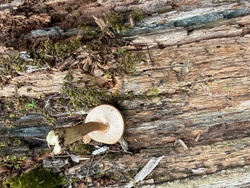
Bitter Bolete
Tylopilus felleus
Also called bitter tylopilus
A robust brown-capped bolete with white pores that flush pink with age and a pale stipe carrying a bold dark brown network. Widespread in conifer and mixed woodland.
Overview
The Bitter Bolete is the type species of Tylopilus, the genus of boletes defined by pink to vinaceous spore deposits and pore surfaces that shift from white to pink as they mature. It is one of the most frequently encountered large boletes across the northern hemisphere and is often the first pink-spored bolete a field student learns.
In stature it resembles the classic porcini profile: a heavy brown cap on a swollen pale stalk. The differences are in the details, and they are consistent. The pores whiten then pink instead of staying white then yellowing, and the stipe network is dark brown and coarsely meshed rather than fine and white.
Because it is common, large and long-lasting, it is a good species for practising the habit of checking spore colour, pore colour change and reticulum colour together rather than relying on overall impression.
How to identify it
Cap
The cap is 5-15 cm or more across, hemispherical when young and expanding to convex or nearly flat. The surface is dry, matt and finely velvety at first, becoming smooth and sometimes slightly greasy after rain. Colour ranges from pale tan and buff through ochre to warm mid-brown or chestnut, usually even across the cap.
Pores
The pore surface is white in youth, then cream, and finally a clear dull pink to flesh-pink as the spores ripen. Pores are small and round, becoming wider and angular in age, and the tubes are depressed around the stipe. Bruising causes brownish stains on the pore surface.
Stipe
The stipe is 4-12 cm tall and 2-4 cm thick, characteristically club-shaped or bulbous below and tapering upward. It is cream, buff or pale brown and is covered, at least on the upper half and usually much further down, by a conspicuous coarse network of dark brown ridges. This dark net on a pale stalk is the single most useful field mark.
Flesh & spore print
The flesh is thick, firm and white, unchanging or turning faintly pinkish where cut, and never blueing. The spore print is pinkish-brown to vinaceous.
Where and when it grows
Tylopilus felleus grows on acid soils in coniferous and mixed woodland, showing a marked preference for spruce and pine, and also occurring under beech and oak. It very often fruits beside old stumps, on rotting buried wood, on mossy banks and along the raised edges of forest tracks, singly or in scattered troops.
Fruiting runs from midsummer to late autumn, peaking in cool damp weather from August to October. The species is widespread and common throughout Europe, temperate Asia and eastern North America, and follows planted conifers into new regions.
Ecological role
This bolete is ectomycorrhizal, forming sheathed root tips principally with spruce, pine and beech. The fungal mantle intercepts nutrients from decomposing litter and mineral soil and passes them to the host in exchange for photosynthate, making the fungus an important part of the nutrient economy of conifer plantations and old mixed woods alike.
Its habit of fruiting around stumps reflects the concentration of fine host roots and organic matter in those pockets rather than any wood-rotting ability. The large fleshy fruitbodies are quickly exploited by fungus gnats, rove beetles and slugs, and the collapsing tissue returns nitrogen to the surface soil.
Similar species
The most frequent confusion is with the porcini group (Boletus edulis and relatives), which have a fine white to pale brown reticulum on a pale stipe, pores that pass from white to yellow and then olive rather than pink, and an olive-brown spore print. Checking the pore colour of a mature specimen and taking a spore print resolves it every time.
The Violet-gray Bolete (Tylopilus plumbeoviolaceus) shares the pink pores and pinkish spore print but has a violet-purple cap and a violet, essentially smooth stipe. Tylopilus rubrobrunneus is larger and purple-brown capped with a smooth pale stipe lacking a coarse dark net. The Gray Bolete (Retiboletus griseus) has a similar coarse net but a grey cap, grey pores that never turn pink, and an olive-brown spore print.
Common questions about Bitter Bolete
How do I distinguish the Bitter Bolete from a porcini at a glance?
What colour is the spore print?
Why is it so often found next to stumps?
Does the flesh change colour when cut?
Guides
Bitter Bolete found by the community
Photos submitted through the app and matched to this entry.