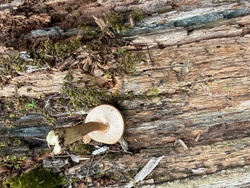
Identification guide
Bitter Bolete Identification Guide
How to place Tylopilus felleus in the field using structure alone: pores that turn from white to flesh-pink, a coarse dark net on a stout stipe, and a pinkish-brown spore print.
First impression and setting
The usual encounter is on acidic, sandy or peaty ground in conifer plantation or mixed woodland, from midsummer through autumn, often on a mossy bank, along a ride edge, or beside a rotting stump where the soil is thin and root-filled. A stout, pale tan to olive-brown bolete stands in the litter, sometimes singly, sometimes in loose troops, and the first thing you register is bulk: a thick, clubbed stipe carrying a broad, dry, dull-brown cap.
At this stage it looks like several other brown boletes, and beginners routinely file it under one of them. Two characters will settle it within a minute, and neither needs anything beyond your eyes and a hand lens: the colour of the pore surface, and the pattern on the stipe.
Reading the cap
The cap is 6 to 15 cm across, occasionally much larger, hemispherical when young and expanding to broadly convex or almost flat. It is dry, finely felted or suede-like when fresh, becoming smooth and slightly polished in age or after rain.
Colour spans pale tan, clay-buff, olive-brown, tobacco and dull mid-brown, usually uniform across the cap with a slightly paler margin. It is neither the rich chestnut of Imleria badia nor the pale-rimmed bronze-and-buff of Boletus edulis, though colour alone is too variable to be decisive. The margin is smooth and even, without an overhanging veil or a striate edge, and the flesh beneath it is thick.
The pore surface, and the first key character
Turn the cap over. In very young buttons the pore surface is white and finely stuffed, which is exactly why the species gets misplaced. Watch it as the mushroom matures: within a day or two the white turns cream, then a soft flesh-pink, and finally a dull dirty pink or pinkish brown. That pink is the single most useful field character.
Pores are small and round when young, becoming wider and slightly angular with age, and the whole tube layer becomes noticeably swollen and cushioned, bulging below the cap margin in older specimens. Press it firmly with a thumb. The bruise is brownish or dull ochre-brown, developing over a minute or so, without any blue phase. The tubes are depressed around the stipe apex and separate easily from the cap flesh.
If the pore surface is still stubbornly white, look at the very margin of the tube layer under a lens, where maturity arrives first, and check the spore print instead.
The stipe, and the second key character
The stipe is 6 to 12 cm tall and 2 to 4 cm thick, distinctly club-shaped or swollen toward the base, firm and solid. Its ground colour is pale ochre, buff or brownish, often paler at the apex.
Now look closely at the upper half with a lens. It carries a raised network, a reticulum, and the character of that net is what matters. In Tylopilus felleus the mesh is coarse, with large, elongated, clearly delimited cells, and it is dark: brown to blackish brown standing out sharply against the paler stipe. It often extends well down the stipe, sometimes almost to the base. Compare that mental image with the net of Boletus edulis, which is fine, delicate, whitish or pale cream, and confined mostly to the top third. Coarse and dark against pale, versus fine and pale against pale, is a distinction you can make at arm's length once you have seen both.
Base, flesh and colour change
Lift the mushroom out whole rather than cutting the stipe, so you can see the base. It is simply swollen and rounded, wrapped in white mycelial cords binding needles and soil. There is no volva, no bulb with a rim, and no rooting tail.
Slice the mushroom in half lengthwise. The flesh is white, thick and firm. On exposure it either stays white or drifts to a faint pinkish or brownish flush in the stipe over ten minutes or so. There is no blueing. Note that carefully, because a rapid blue reaction in the flesh or pores moves you into completely different genera. The smell is mild and mushroomy, not aromatic and not sharp.
Taking and reading a spore print
Cut the cap from the stipe, set it pore-side down on white paper, cover with a bowl and leave three to six hours. Mature caps drop generously.
The print is pinkish brown, flesh-brown or vinaceous brown. That is the decisive laboratory-free confirmation, because the entire Boletus group that this species mimics drops an olive-brown to snuff-brown print instead. Gather the deposit into a small ridge with a blade and judge it in daylight, since a thin scatter always looks washed out. Under a microscope the spores are spindle-shaped and smooth, roughly 11 to 15 by 4 to 5 micrometres, with a pale pinkish tint in mass.
Substrate, season and ecology
Tylopilus felleus is ectomycorrhizal, forming sheaths on the fine roots of its partner trees and trading soil nutrients for photosynthate. In Europe it is most consistently associated with spruce and pine, particularly on sandy, acidic or leached soils, and it also partners beech and oak. In North America it is common in mixed and coniferous woods on comparable ground.
It fruits from June or July into October, favouring warm, humid spells. A characteristic micro-habitat is the mossy margin of an old conifer stump or a bank of thin acidic soil over sand, and fruit bodies there are often unusually large and long-lived, remaining firm and recognisable for well over a week, which is longer than most soft-fleshed boletes manage.
Separating it from look-alikes on morphology alone
Boletus edulis and B. reticulatus are the classic confusion. Their pores are white then yellow to olive-yellow, never pink, their net is fine and pale on a whitish to pale buff stipe, and their spore print is olive-brown. The cap margin of B. edulis also frequently carries a fine white bloom.
Caloboletus calopus has a whitish to grey cap, yellow pores, a strikingly red-flushed lower stipe with a net, and flesh that turns blue promptly when cut.
Tylopilus plumbeoviolaceus shares the pink pores and pinkish print but has a violet to purple-grey cap and stipe when young, fading to brown.
Leccinum species have stipes roughened with scabers rather than a raised net, and their prints are olive-brown.
Imleria badia has a smooth stipe with no net at all, a chestnut cap and pores that flush blue-green when pressed.
Rubroboletus and other red-pored species are obvious once you look at the pore colour, which is orange to blood red rather than pink.
Field checklist
Dull brown dry cap, pore surface ageing white to flesh-pink, coarse dark net over much of a swollen pale stipe, white flesh with no blueing, and a pinkish-brown print. Together those are Tylopilus felleus.
Common questions
The pores on my specimen are still white. How do I proceed?
What trees and soils should I search?
How reliable is the stipe net as a field character?
Why do the fruit bodies last so long compared with other boletes?
Full reference entry for Bitter Bolete
Cap and fruiting body, spore print colour, substrate, season, ecological role and the species most often confused with it.
Open the Bitter Bolete entry →